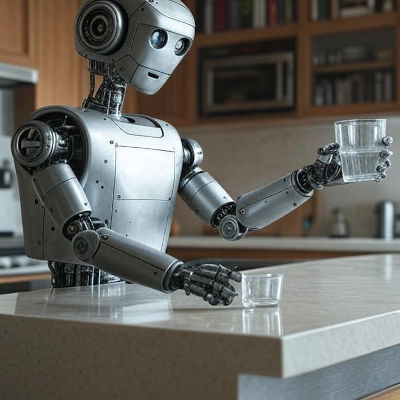

Artificial intelligence (AI) chatbots have improved quickly in recent years and are now used for tasks like helping people personally, serving customers, or even providing therapy. These chatbots run on large language models (LLMs) trained on huge amounts of text from the internet. This success has led some tech leaders, like Elon Musk and Jensen Huang, to predict that similar methods will soon create humanoid robots that can do surgery, work in factories, or act as home helpers in just a few years. However, robotics expert Ken Goldberg from UC Berkeley disagrees, pointing out major hurdles that will slow this down.
In a paper published in Science Robotics, Goldberg explains the "100,000-year data gap," which is the huge difference in available training data between language AI and robots. For chatbots, the internet provides text that would take a human about 100,000 years to read, allowing quick learning of language skills. Robots need far more data for physical tasks, but gathering it is hard. Videos of humans don't capture precise 3D movements, simulations work for simple actions like jumping but fail for fine handling, and teleoperation is slow and only adds data hour by hour.
The debate over robot development paths
Goldberg notes that robots struggle most with dexterity, the skill to handle objects carefully, like picking up a glass or changing a bulb. This is due to Moravec's paradox, where tasks easy for humans are tough for machines, unlike complex games like chess that AI masters easily. Robotics is shifting paradigms, meaning a big change in thinking, with a debate between traditional engineering - using physics, math, and models - and a new data-only approach pushed by younger experts and investors.
To move forward, Goldberg suggests combining engineering to make robots good enough to collect real-world data over time, like self-driving cars that improve as they operate. On jobs, physical blue-collar work in trades seems safe for a long time, while some routine office tasks, like filling forms, may automate. However, roles needing empathy, such as customer service or delivering bad medical news, will likely stay human. Overall, fears of robots taking all jobs are overstated, as humans have unique strengths that machines won't match soon.