

Introduction
Mathematical reasoning has long been a proving ground for artificial intelligence. Yet the ability to tackle complex math tasks has often remained elusive for large language models (LLMs), whose sophistication comes at the cost of compute-heavy training and deployment. In a significant leap forward, researchers at Microsoft have introduced rStar-Math, a groundbreaking framework that turns this assumption on its head. By harnessing the strategic planning power of Monte Carlo Tree Search (MCTS) and enabling self-evolutionary training, rStar-Math allows small language models (SLMs) to perform at the highest levels of mathematical reasoning—without requiring guidance from massive teacher models.
This development isn't just a technical triumph—it’s a shift in the AI landscape. rStar-Math doesn’t just compete with industry giants like GPT-4 or Gemini—it often surpasses them, all while remaining lightweight and resource-efficient. And it's open-source.
From Imitation to Deep Thinking: The rStar-Math Framework
Monte Carlo Tree Search as the Engine
At the heart of rStar-Math is a bold departure from the imitation learning paradigm that underpins most SLMs. Traditional fine-tuning teaches models to mimic expert solutions. rStar-Math, in contrast, encourages models to explore, evaluate, and improve solutions via search—specifically, through Monte Carlo Tree Search.
In this setup, a math policy SLM serves as the "actor," proposing reasoning steps to solve math problems. These steps are not evaluated in isolation. Instead, a second model—the Process Preference Model (PPM)—acts as a critic, judging entire trajectories of reasoning. The PPM scores whether a full solution path is valid and meaningful, not just whether it arrives at the correct answer. In essence, the model is learning to think like a human mathematician, weighing both destination and journey.
Generating Knowledge from Scratch: Code-Augmented Data Synthesis
One of the primary obstacles in training math-capable SLMs is the lack of diverse, high-quality training data. Rather than relying on curated datasets or distillation from LLMs, rStar-Math builds its own data. Using MCTS, the framework synthesizes chain-of-thought (CoT) solutions to over 747,000 math problems from sources like the MATH and GSM8K benchmarks.
Each step in a generated solution is validated by Python-based symbolic execution—code that confirms the logical correctness of the reasoning path. This process not only ensures mathematical accuracy but also creates a feedback loop in which the model refines its own performance over time.
By executing the CoT steps programmatically, rStar-Math closes the loop between language-based reasoning and symbolic correctness, a hybrid approach that's still rare in most LLM training regimes.
Self-Evolution Without Distillation
Perhaps the most radical feature of rStar-Math is what the researchers call self-evolved deep thinking. Unlike many recent frameworks that depend on larger teacher models to bootstrap performance, rStar-Math trains its models entirely from scratch, using only its own reasoning outputs to improve.
The framework proceeds through four training rounds. In each round, the math policy model and the PPM jointly improve by generating new data, evaluating it, and refining their internal parameters accordingly. This iterative self-improvement mimics the metacognitive loop—an AI teaching itself not just what to think, but how to think better.
The result is a compact model that can solve increasingly complex math problems without any external guide—an autonomous learning engine that evolves through structured reflection.

Redefining Benchmarks in Mathematical Reasoning
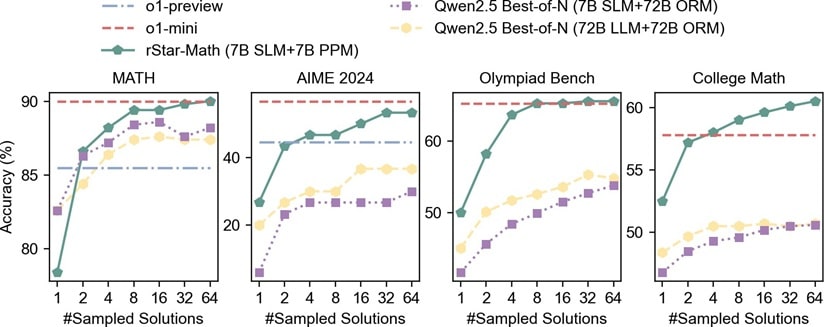
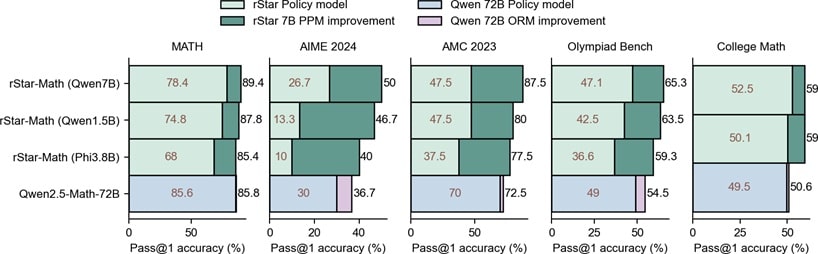
rStar-Math's effectiveness isn't merely theoretical. Across a battery of rigorous benchmarks, it achieves state-of-the-art results—often outperforming models many times its size.
- MATH Benchmark: Using rStar-Math, the Qwen2.5-Math-7B model achieved 90.0% accuracy, a massive improvement over its base performance of 58.8%. Similarly, Phi-3-mini-128k-3.8B jumped from 41.4% to 86.4%. Both results surpass OpenAI’s o1-preview, a leading model.
- AIME (American Invitational Mathematics Examination): The system correctly solved 8 out of 15 problems, ranking in the top 20% of high school competitors—without any task-specific engineering.
- GSM8K (grade school math) and MATH-401 (symbolic subset) also showed consistent gains in both accuracy and reasoning depth.
These results suggest not only high precision but also generalizability across domains of arithmetic, algebra, geometry, and symbolic computation.
How It Works in Practice: The MCTS Pipeline
The pipeline behind rStar-Math is both elegant and sophisticated:
- Generation: The math policy model generates multiple solution paths per problem, simulating strategic variations.
- Evaluation: The Process Preference Model scores each path based on logical coherence and problem correctness.
- Selection: The best-performing paths are chosen as training data.
- Symbolic Verification: Code execution ensures each reasoning step produces correct intermediate and final results.
- Iteration: The models are re-trained with this data, progressively refining their skills.
This approach effectively blends exploration (via MCTS) with evaluation (via PPM) and symbolic correctness (via Python code) into a closed training loop.
Broader Impact: From Labs to Classrooms and Beyond
Accessibility and Efficiency
While GPT-4 and Gemini require significant infrastructure, rStar-Math’s SLMs can run efficiently on far fewer resources. This makes them ideal for university labs, startups, or developers with limited compute budgets.
Even more notably, the entire codebase and training data are open-sourced. This sets the stage for widespread experimentation and collaboration across the AI research community, effectively democratizing access to advanced math reasoning.
Educational and Industrial Use Cases
rStar-Math’s ability to explain solutions step-by-step makes it a powerful candidate for intelligent tutoring systems. Rather than simply providing answers, it can guide students through the reasoning process—turning AI into a patient teacher.
In industry, its reasoning capabilities could support automated theorem proving, scientific modeling, or complex financial simulations, offering explainability and verifiability in mission-critical settings.
Limitations and Future Horizons
Despite its success, rStar-Math does face several challenges:
- Symbolic Reasoning: While the system excels in numerical and algebraic problems, extending MCTS to geometric or symbolic domains remains an open problem.
- Data Diversity: Current synthesis methods may struggle with very rare or exotic problem types. Techniques to diversify and robustly sample new tasks will be needed for broader coverage.
- Generalization Beyond Math: Although the researchers mention the possibility of adapting rStar-Math to tasks like code generation, formal proof, or even non-mathematical reasoning, these directions remain speculative for now.
Conclusion
rStar-Math represents a milestone in the evolution of AI reasoning. By equipping small models with deep-thinking tools like Monte Carlo Tree Search and enabling them to self-evolve without external supervision, Microsoft has laid the groundwork for a new class of capable, efficient, and widely accessible AI systems.
Its impressive performance across mathematical benchmarks, combined with its open-source ethos, signals not just a technical breakthrough but a philosophical one. In a field dominated by brute-force scale, rStar-Math offers a compelling alternative: intelligent design, careful training, and thoughtful reasoning—achieved with fewer resources and more transparency.
The next wave of AI might not be bigger. It might just be smarter.
Reference
Guan, Xinyu, Li Lyna Zhang, Yifei Liu, Ning Shang, Youran Sun, Yi Zhu, Fan Yang, and Mao Yang. “rStar-Math: Small LLMs Can Master Math Reasoning With Self-Evolved Deep Thinking.” arXiv.org, January 8, 2025. https://arxiv.org/abs/2501.04519.