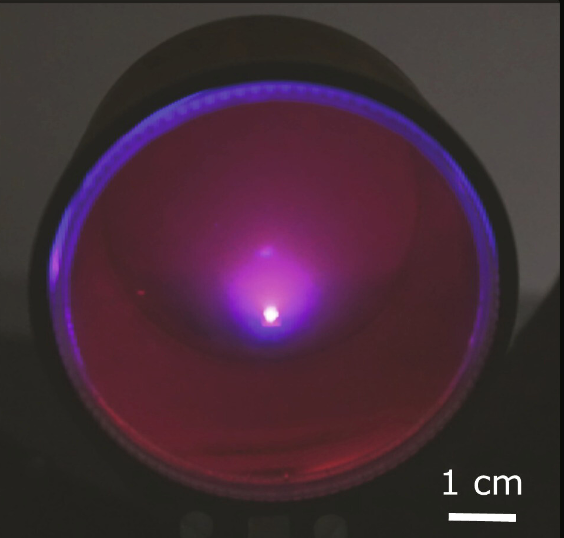

Researchers have invented a radical new wireless light source that might one day make it possible to "illuminate" the human body from the inside.
This minimally invasive design could allow for better understanding and treating diseases that currently require implanting bulky devices.
The new approach, described in the open-access journal Science Advances, was developed by a research team from the University of St Andrews and the University of Cologne in Europe.
Optical brain stimulation using wireless OLEDs
The design is based on integrating organic light-emitting diodes (OLEDs, commonly used on smartphones and televisions) on compact "acoustic antennas."
Such optical stimulation techniques have emerged as a promising alternative to electrical stimulation because they can be more cell-selective, down to stimulating individual cells. This compares to conventional brain stimulators, which often incorporate a large number of electrodes.
Tech details
OLEDs consist of thin layers of organic materials that can be applied to almost any surface. The researchers exploit this property to deposit OLEDs directly onto the acoustic antenna, merging the unique properties of both platforms into a single extremely compact device.
In this way, acoustic antennas serve as substrate and power source for the custom-developed OLED. The antennas convert energy from a magnetic field into a mechanical oscillation and subsequently into an electric current by the "composite magnetoelectric effect."
Wireless light source combines minimal device size, low operation frequency and optical stimulation
The new devices operate at sub-megahertz frequencies, a frequency range used for example for submarine communication, as electromagnetic fields at this frequency are only weakly absorbed by water. However, the intended application in biomedicine requires a small device in order to avoid a negative impact on the tissue.
“Many emerging applications require multiple sites to be stimulated independently, which is why modern brain stimulators often incorporate a large number of electrodes, said Humboldt Professor Dr Malte Gather, head of the Humboldt Centre for Nano- and Biophotonics at the Department of Chemistry of the University of Cologne’s Faculty of Mathematics and Natural Sciences.
No bulky electronics
"In the case of our wireless light sources, the devices can be independently controlled and operated without the need of additional and potentially bulky electronics.”
This is possible because the operation frequencies of different acoustic antennas can be tuned to different values. In the future, this could allow for the individual control of multiple stimulators in different parts of the body, to treat tremor in the late stages of Parkinson's disease, for example.
Citation: Butscher, J. F., Hillebrandt, S., Mischok, A., Popczyk, A., H. Booth, J. H., & Gather, M. C. (2024). Wireless magnetoelectrically powered organic light-emitting diodes. Science Advances.