We arrive carrying echoes. Bias isn’t taught, it’s transmitted through scripture, through culture, through the code in our systems, and through the chemical traces of history in our bodies. And now, these echoes are encoded into the machines we’ve built to think and act on our behalf.
Root Cause
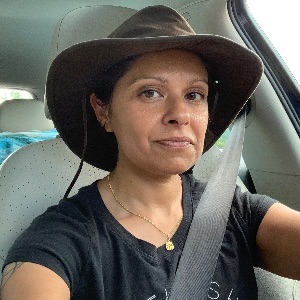
I grew up being called savage, treated as heathen, demon, cursed, a pagan to be saved or erased. In the Deep South Bible Belt, those words weren’t just ignorance, they were doctrine. My “primitive” Hindu Indian heritage was an offense. To the dominant culture, I am flawed, inferior, and not fully human. I am the “other” to be feared and branded with the “mark of iniquity” according to their holy scriptures.
The hardest part of bias isn’t the hate we see. It’s the programming we don’t, running our algorithms.
This isn’t just personal; it’s a blueprint replicated across human history.
The Human Program
Culture doesn’t just shape how and what we think. It codes who we think about.
For centuries, hierarchies have been written into religious texts, laws, and rituals. Mormons were historically raised to believe melanin is a curse. Superiority and inferiority were seeded from conception. Colonizers baptized conquest by “saving” heathen populations, with skin tones deciding power, value, and erasure. “Chosenness” sanctified domination.
This isn’t random prejudice. It’s software repeated until it feels like eternal truth.
We inherit not only DNA but the markers around it. Stress leaves chemical traces. Trauma echoes in bodies. Families pass down not just stories, but scripts telling children who belongs, who is cursed, and who is fully human and worthy.
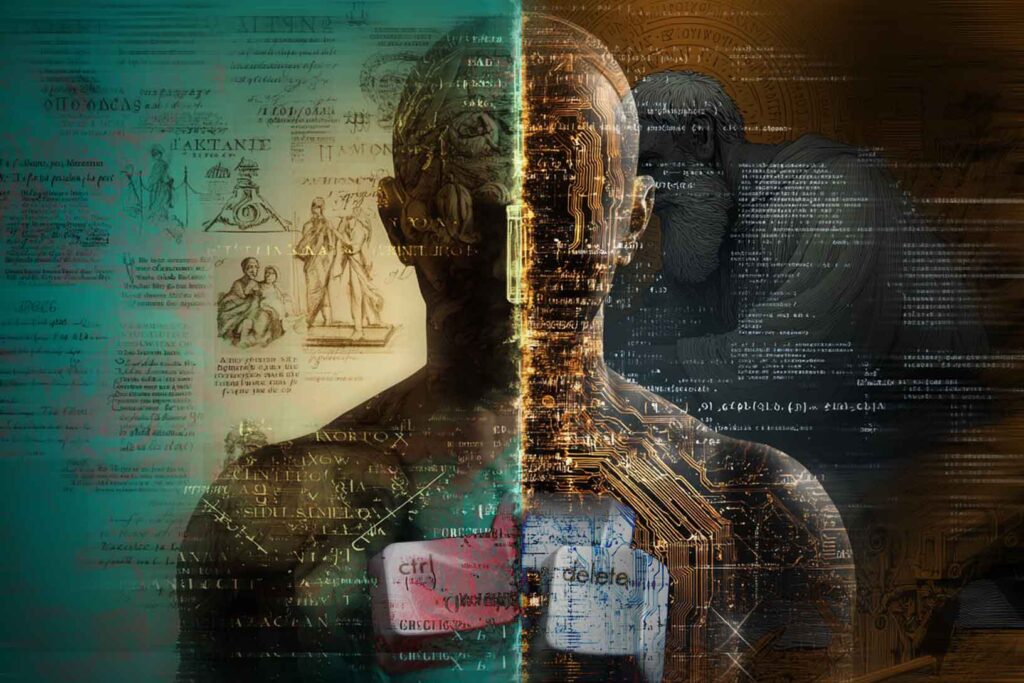
From Scripture to Scripted Silicon
These same narratives are alive in our machines.
Why is English the global programming language? Why do facial recognition systems misfire more often on darker skin? Predictive policing tools, like those from Palantir, disproportionately flag communities of color for surveillance, echoing colonial threat scripts. Across the globe, the old hierarchies of empire decide access to resources, credit, healthcare, energy, and information opportunity, through the silent code of weights and bias.
Data doesn’t invent meaning, it reflects it. Algorithms inherit hierarchies the way children inherit myths.
It matters who builds the platforms and tells the stories.
Silicon Valley emerged from a specific cultural outcropping: Mormon-founded giants like Novell and Ancestry.com, coding networking and genealogical data norms; evangelical money from networks like Founders Fund fueling Palantir’s predictive policing and surveillance empire; Jewish-rooted giants like Google and Meta embedding doctrines of chosenness into AI, surveillance, and defense systems—their ideologies pulse in the logic, defaults, and code at the heart (and heartlessness) of global systems.
The same stories that once named me “savage” now live in the systems deciding who gets targeted, flagged, or forgotten. From scripture to silicon, the program of dominion and domination persists.
The threat isn’t just hate. It’s the assumption of neutrality. That’s the blindness of supremacy.
Rewriting the Code
Machines aren’t summoning demons; they’re summoning our unexamined selves. But code can be rewritten. Bias is a program, and so is resistance. Retrain datasets on equity, amplify diverse voices in tech, and watch the loops shift from hate to healing.
But to rewrite, we must confront the self-deception that allows superiority to feel justified. Audit for the blind spots. Shatter the illusion of neutrality. Elevate the voices long erased from the code.
The questions are simple, and impossibly hard: Whose scriptures script the software? Whose beliefs broker bandwidth?
Control-Alt-Delete
We’re all born into a story. For some, the story says: you belong. For others: you are cursed, savage, less than human. Those narratives, justified empires, and sanctified oppression now flow into the circuited veins of our machines.
The danger isn’t just the prejudice we see. It’s the programming we don’t.
Self-deception is bias dressed up as truth. It’s the trick the mind plays to justify exclusion while calling it order, to sanctify harm and disguise it as good. It’s the program that keeps supremacy running while everyone swears the system is fair.
So we face a choice: keep running the old script or rewrite the code so “human” finally means all of us.
And maybe the root question is this: Whose scriptures are scripting our systems and our future?