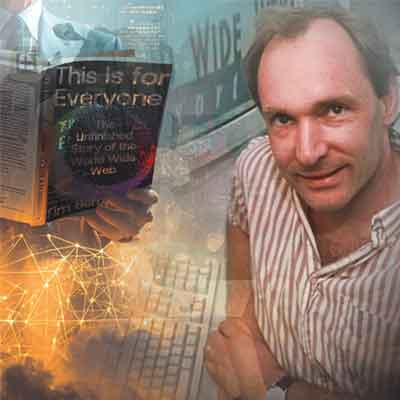

I've been reading (actually devouring) the book "This Is for Everyone: The Unfinished Story of the World Wide Web" (2025) by Tim Berners-Lee, the "father of the Web."
The book is a compelling memoir and manifesto that traces the origins, evolution, and potential future of the web. It serves as both a personal reflection from the web's inventor and a call to action for reclaiming its democratic ideals. Berners-Lee sees technology as a tool for collaboration rather than control.
The story begins with Berners-Lee upbringing and quickly moves to with his time as a young engineer at CERN in the 1980s. He envisioned a system that would link documents across computers globally. In 1989, he proposed what would become the web: a decentralized network where information could be accessed and shared freely through hyperlinks.
I was at CERN in the 1980s and vividly remember the computer machinery of that times, which Berners-Lee aptly describes with evocative word pictures. I must have met him and talked to him at CERN, but I don't remember. I do remember calling him in 1990 or so, when I was at the European Space Agency, to discuss the potential of this very new thing called the web.
The early web
Berners-Lee developed the first building blocks of the web and gave them the names we use today: Uniform Resource Locators (URLs) for addressing web pages, Hypertext Transfer Protocol (HTTP) for transmitting data, and Hypertext Markup Language (HTML) for structuring content. He emphasizes that his decision to release these without patents or royalties was deliberate, aiming to make the web accessible to everyone, not just corporations or governments.
This ethos is encapsulated in the book's title, echoing his message to the world at the 2012 London Olympics opening ceremony, where he appeared typing "This is for everyone" on stage.
Berners-Lee describes bureaucratic hurdles at CERN, followed by the web's rapid growth in the 1990s, and the early browsers like Mosaic and Netscape. From academic sharing to the rise of e-commerce and social platforms, the web transformed society, enabling global collaboration and innovation.
I was expecting Berners-Lee's book to be mainly a history book - a chronicle of the early development of the web. But most of the book deals with more recent issues and current issues.
Reclaiming the web
Berners-Lee was the director of the World Wide Web Consortium (W3C), founded in 1994 to standardize web technologies. He details battles to keep the web open, including resisting attempts to create proprietary networks that could fragment the internet. A key theme is net neutrality - the principle that internet service providers should treat all data equally, without favoring certain content. Berners-Lee recalls his efforts to prevent a tiered internet where only the wealthy could access premium speeds. These sections highlight his optimism about the web's potential while acknowledging early warning signs of misuse, like spam and misinformation.
Unfortunately the web has deviated from its original promise. Berners-Lee discusses threats like fake news and algorithmic biases that polarize societies, drawing on examples from elections and social movements. He laments the concentration of power in tech giants like Google, Meta, and Amazon, which monetize user data for profit, eroding privacy and amplifying echo chambers. But, he says, we can fight back and reclaim the web.
Berners-Lee draws parallels between the web's development and broader societal shifts, emphasizing inclusivity - making technology accessible to the disabled, the global south, and future generations. The narrative is optimistic in tone, asserting that with collective effort, we can reengineer the digital world for equity and creativity.
Berners-Lee frequently makes the point that the web was born decentralized. There was "a diffuse, decentralized structure to the early web which I very much enjoyed," he says. "As there was no YouTube or Facebook sucking up the majority of the traffic, every site had a shot at the big time." Then (one might add "of course"), the bad big boys have centralized the web. The web's current model prioritizes clicks and ads (and surveillance) over human flourishing. But now, "the web has become more and more subject to capitalist forces tending towards monopolization," says Berners-Lee, and "we must return to the decentralized structure I originally envisioned for the web."
Solid and Inrupt
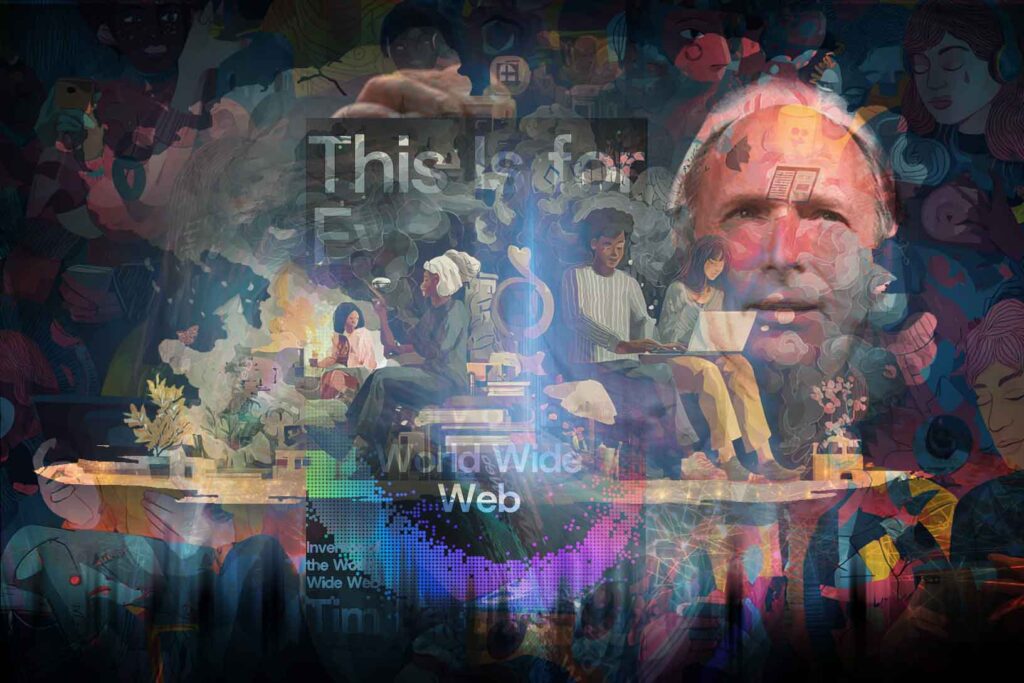
Central to Berners-Lee's quest to reclaim the web is the Solid project, a decentralized data storage system that he has championed since 2015. Solid allows individuals to store personal data in secure, user-controlled digital vaults, rather than handing it over to corporations. This, he posits, would empower people to manage their information, sharing it selectively with apps or services. Berners-Lee envisions Solid enabling personalized AI assistants that analyze one's data to offer insights into health, finances, or self-understanding, without privacy breaches. He provides examples of Solid in action, such as in healthcare for secure patient records. Berners-Lee founded a company called Inrupt to advance his vision. However, he acknowledges challenges, like adoption barriers and technical complexities.
The rise of AI
The rise of artificial intelligence (AI) and machine learning receives particular attention. While admitting that AI can be used for bad things, e.g. creating deepfakes and spreading misinformation or disinformation that contributes to toxic political polarization, Berners-Lee is optimistic on the use of AI for good things.
Concerning AI itself, Berners-Lee briefly elaborates on the difference between the Good Old-Fashioned AI based on logic and rules and today's approach based on neural networks and big data (the difference between "thinking" and "feeling" AI described in De Kai's recent AI book).
Concerning the prospect of AI consciousness, Berners-Lee goes back to Alan Turing's insight: "there is no difference between simulating consciousness and having it," he says. Any intelligence "is what it appears to be." Today's AI, he points out, "resoundingly passed the Turing Test."
Berners-Lee admits that artificial superintelligence with strange goals of its own could be a major problem, and the alignment problem "is the biggest one we face." The complex behaviour of large neural networks will soon approach our own, and this is "a hard problem, arguably the hardest and most important in computer science."
But on the other hand, "it’s equally a mistake to focus only on the risks, when there is so much potential for these systems," he says.