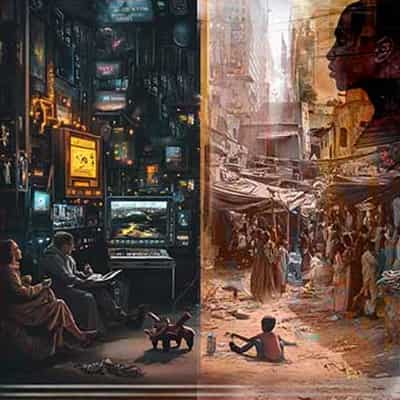

The West is Afraid of Robots. The Global South is Afraid of Today: A Dark Comedy in Three Acts

The West is Afraid of Robots. The Global South is Afraid of Today: A Dark Comedy in Three Acts

Existential dread and kale smoothies: Professor Begelaw’s satirical interview exposes the absurdity of the West's AI panic while real-world crises rage on.
HT
Hruy Tsegaye
Mar 25, 2025
12 min read

When Simulations Collide: A Sarcastic Chronicle of Western Panic, AI Doomers, and the People Who Just Want Lunch

Act One: The Prologue: On Simulated Fears & the Luxury of Existential Panic 

Yesterday (this piece was originally drafted on March 06, 2025, but editing took longer than expected), I read a deeply unsettling feature in The Guardian titled ‘They wanted to save us from a dark AI future. Then six people were killed’. If I was the writer I would have titled it From Code to Chaos: The Radical Descent of an AI Prophet’. The piece, a fantastic one, chronicled the journey of Ziz, a once-obscure programmer in the San Francisco Bay Area, who mutated from an AI risk theorist into an alleged architect of domestic terrorism. Her story, a grotesque parable of our times, left me equal parts baffled and nauseated. As a born-and-raised Ethiopian, my psyche, steeped in the ‘pragmatism’ of the Global South, struggles to parse the West’s obsession with abstract apocalypses while concrete suffering festers in plain sight.

On my second read, I attempted to distill the article’s central thesis. To my mind, it is this: Extreme ideological conviction, when divorced from material reality and amplified by insular subcultures, becomes a self-fulfilling prophecy of violence. Ziz’s followers, marinating in rationalist jargon and AI doomerism, weaponized her theories into a crusade against a world they deemed already doomed. A cautionary tale, yes... but one that feels like a parody when viewed from Addis Ababa in Ethiopia, where existential risk is not a thought experiment but the daily calculus of survival: “Will the water run today?” Or if it is from Bahir Dar, Ethiopia: “Will the drone strike miss?”

This cognitive dissonance between Western existential fabulism and the Global South’s grinding present led me to consult my favorite imaginary contrarian thinker: Professor Darios Begelaw, the mercurial Ethiopian physicist and co-discoverer of the Four Laws of Simulated Reality. For those unacquainted with his work, I recommend reading my previous article, where terms like ‘Berbere’, ‘Ketema’, and ‘Merkato’ are explained.

Begelaw is equal parts genius and gadfly, a man who argues we inhabit a glitchy simulation run by “incompetent demigods with a fetish for irony.” He is also, notably, the least politically correct intellectual alive, a quality that makes him uniquely suited to dissect Western neuroses, I guess this is why my mind always runs to ‘Prof’ whenever I am facing such discourses.

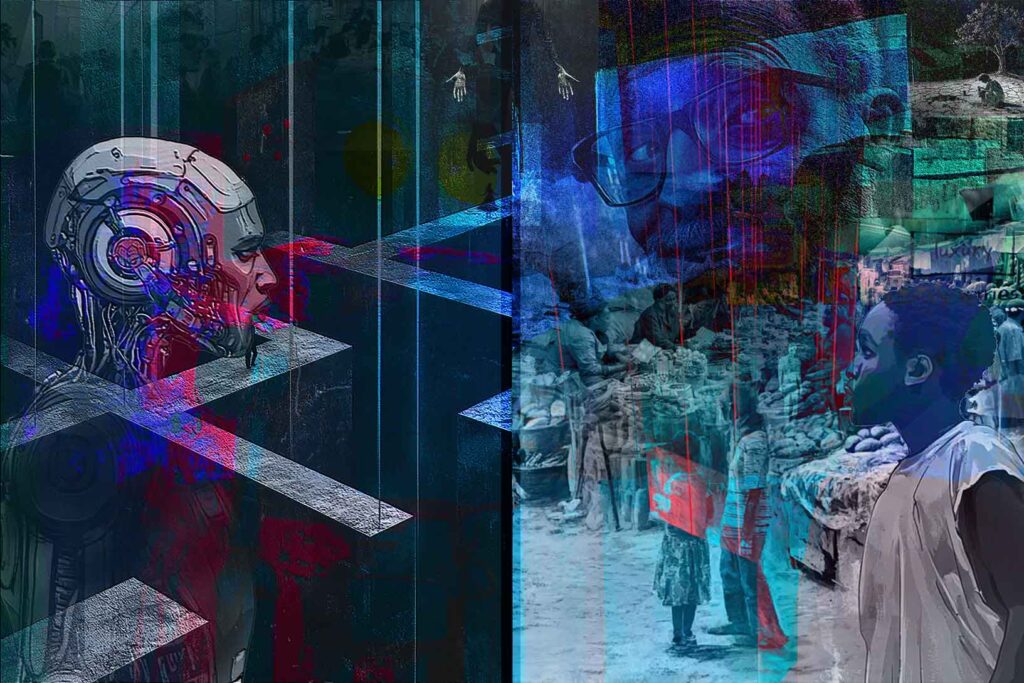
Reaching Professor Begelaw is no small feat. He resides in Addis Ababa’s crumbling Merkato district called Berbere Tera, a place where “the internet” is a rumor and smartphones are relics of a decadent future. Our correspondence relies on a chain of messengers: elderly women who trade his handwritten ‘screeds’ for bags of berbere pepper. When I shared The Guardian piece and asked his thoughts on AI risk cults, he responded with characteristic bile: “The West fears tomorrow’s fiction while selling yesterday’s lies. Send cigarettes!”

What followed was a blistering essay (published below as Act Two) that reframes Ziz’s story not as an anomaly, but as the logical endpoint of a civilization unmoored from reality. Begelaw mocks Silicon Valley’s “apocalypse cosplay,” and contrasts it with the quiet resilience of Gaza’s bakers and Merkato’s merchants, and concludes, with typical gloom, that the West’s “simulated fears” are a luxury the Global South cannot afford.

To contextualize his claims, I conducted a short interview (Act Three). True to form, Begelaw answered questions between power outages, pausing only to heckle passersby and lament the price of qetema. His tone is abrasive, his analogies crude, and his logic merciless. I have redacted nothing, softened nothing. As he insists: “Offense is the first vaccine against delusion.”

The article and interview that follow are not meant to comfort. They are meant to confront; to juxtapose the West’s speculative panic with the Global South’s immediate struggle. Whether you find Begelaw brilliant or bigoted, his message is unignorable: A world that frets over imaginary tomorrows will starve today. Here, my advice is you should proceed with caution. And I will quote Professor Darios Begelaw from my previous article so you will remember his warning:

When you open your eyes, avoid staring directly at the sun.

-Professor Darios Begelaw
Credit: Tesfu Assefa

[The following pages contain Professor Begelaw’s article and our accompanying interview.]

Act Two: The Article: The West’s Existential Crisis: A Tragicomedy from Silicon Valley While the World Burns Quietly

Subheading: But have you considered the 0.0001% chance AI turns us into paperclips?!” Meanwhile, Gaza rebuilds its third bakery this week. 

The Doomsday LARP (Live-Action Role-Play)

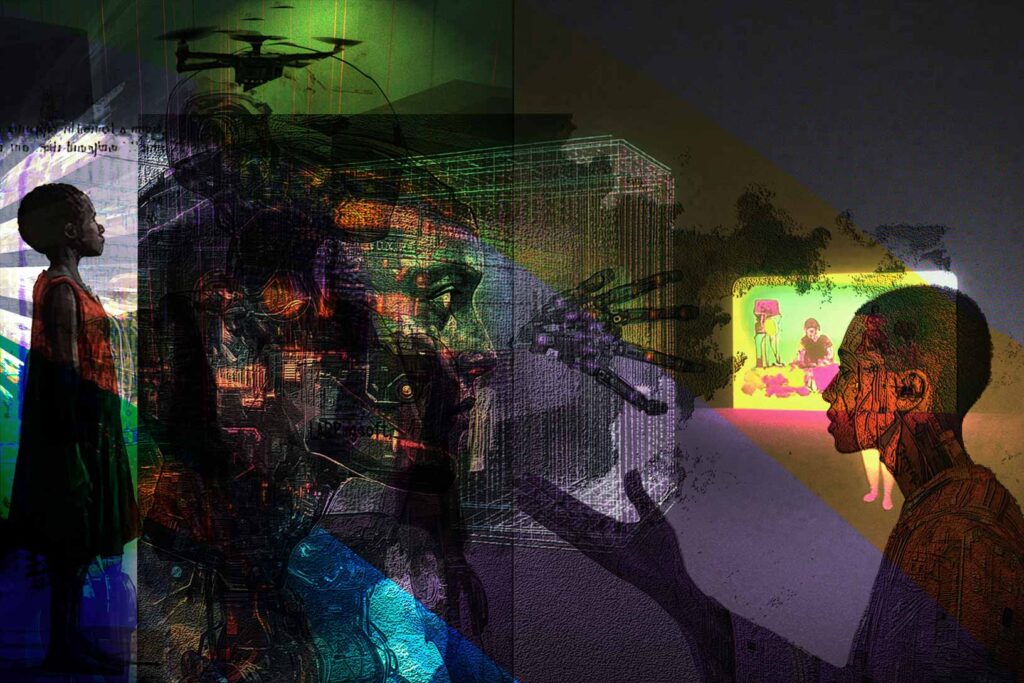
Ah, the West. A land where existential dread is a luxury item, like artisanal kale or a $800 juicer that claims to align your chakras. Enter the ‘Less Wrong’ movement, a group of Silicon Valley philosophers who’ve concluded that humanity’s biggest threat isn’t climate collapse or nuclear war. No, no it’s the vague possibility that future humans might have slightly less ethical fiber. Their manifesto? “If we can’t optimize every hypothetical tomorrow, why even live today?” Cue violins.

Then there’s Eliezer Yudkowsky, the AI Cassandra who’s already written humanity’s obituary. “We’re all dead!” he declares, sipping a fair-trade kale latté in his panic room stocked with 50 years of freeze-dried guacamole. Never mind that actual humans in Sudan or Yemen or even Ukraine are busy dodging actual bullets, not hypothetical rogue algorithms. But sure, Eliezer, keep screaming into the void. The void is fascinating.

And who could forget Sam ‘Altruism™’ Bankman-Fried? The man who pledged to donate all his money to save future beings, right after he finished defrauding billions in the present. The irony! His arrest was a poetic masterpiece: a man so worried about theoretical suffering he forgot real people like not being scammed. Bravo, Sam. The Global South salutes your commitment to performance art.
Credit: Tesfu Assefa

The Optimism of the Already Doomed

Let’s pivot to the Global South, where hope isn’t a think-tank topic, it’s a survival tactic. In Gaza, kids build sandcastles in rubble, mastering the art of “trauma-informed play”. In Lagos, entrepreneurs sell solar-powered phone chargers during blackouts, because who needs a stable grid when you’ve got grit? And in Haiti, farmers plant crops in soil salted by gang violence, muttering, “Maybe next season.”

The bright future here writes itself: A Palestinian grandmother, when asked about her hopes for the future, shrugs and says, “I survived ’48, ’67, and three Israeli offensives. If Skynet wants a turn, habibi, tell it to take a number.” Meanwhile, a Congolese miner laughs at the West’s AI panic: “You fear future machines? We fear present-day machine guns!”

It’s almost inspiring. While the West doomscrolls Twitter debates about ‘longtermism’, an Ethiopian mother barters fuel for medicine and names her child ‘Tesfaye’ (My Hope). Because when your present is a dumpster fire, you don’t have the privilege of crying over tomorrow’s hypothetical ashes.

The Softness of the West, or ‘How to Lose a Civilization Without Trying’

The conclusion? The West has gone soft. Not “avocado toast” soft, more like “collapsed into a quivering puddle at the first sign of discomfort” soft. While academics in Cambridge debate whether breathing is ethical under late-stage capitalism, a Syrian refugee stitches tents in the rain and hums a lullaby.

The West’s threats are hypothetical: AI, asteroids, a misaligned AGI accidentally turning New York into a paperclip. The Global South’s threats are real: drones, droughts, and the lingering ghost of colonialism. But hey, at least Elon’s building a Mars colony for the 12 people who’ll outlive the apocalypse. Priorities!

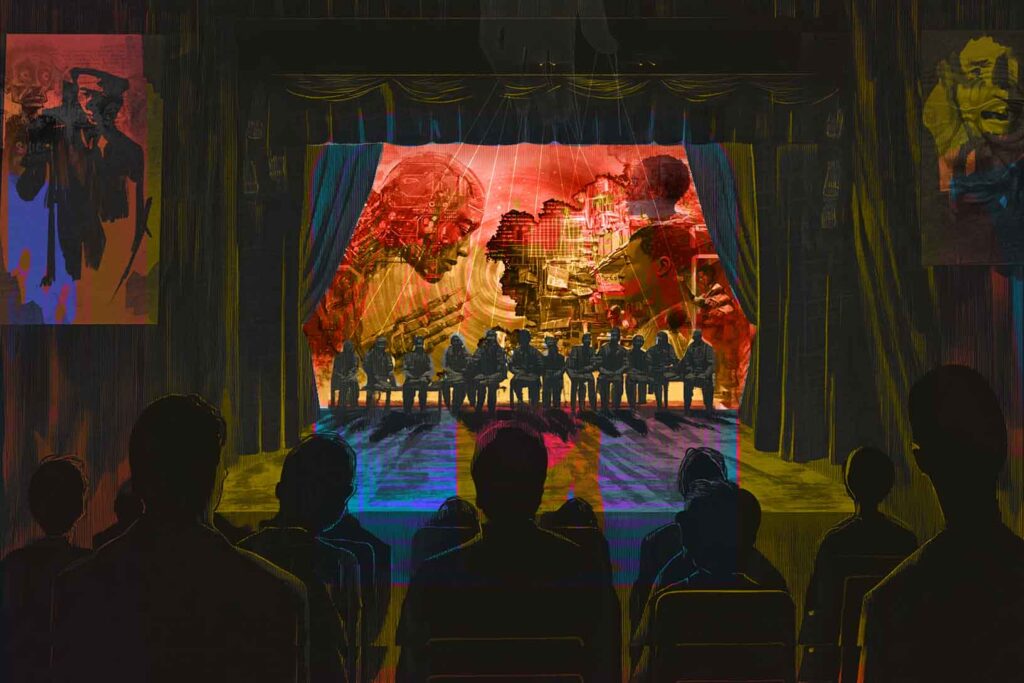
In the end, the joke’s on the West. While they’re busy “saving the future,” the rest of the world is mastering the art of living: finding hope in the ruins, joy in the chaos, and dark humor in the face of oblivion. After all, if you’ve survived genocide, poverty, and being called “resilient” by NPR, what’s a little robot uprising?

Final Line: The West may have invented anxiety, but the Global South wrote the manual on dark comedy. We are all the punchline.
Credit: Tesfu Assefa


Act Three: Interview With Professor Darios Begelaw by Hruy Tsegaye

About the interviewer: The imaginary Hruy is an Ethiopian futurist, essayist, and critical theorist based in Addis Ababa. Some of his work focuses on economic disparities between the Global North and South, aka global inequality. Currently, he does not own a juicer; his broke weeks ago.

Simulated Realities & Western Delusions: A Darkly Humorous Dialogue with Professor Darios Begelaw

Hruy: Professor Begelaw, your team’s Four Laws of Simulation have ruffled feathers. Let’s start with the 2nd Law: Universal Amnesic Syndrome. You claim humanity’s collective forgetfulness proves we’re in a simulation. But isn’t this just… human nature?

Prof. Begelaw: [Laughs, adjusts a cracked pair of glasses.] ‘Human nature’ is the West’s favorite scapegoat! Of course we forget. The USA just ‘forgot’ its coups birthed today’s wars in Ukraine escalating, inshallah, to WW3! Europe just ‘forgot’ colonialism birthed today’s refugees. But when a Sudanese mother forgets her child’s birthday because she’s foraging for water, that’s something else, that’s human nature? No. In a simulation, amnesia is programmed. The West gets selective memory downgrades; the Global South gets the Ctrl+Alt+Del treatment.

Hruy: Your 4th Law, Filthy SSOS (‘Sheer Stupid Shines Over Smart’), mocks Kim Kardashian outselling Stephen Hawking. Isn’t that just… capitalism?

Prof. Begelaw: Capitalism? [Snorts.] Capitalism is Merkato merchants selling flip-flops made of tires while Silicon Valley sells AI ethics to people who’ve never missed a meal. The real simulation is watching Yudkowsky panic about paperclip-maximizing AIs while Gaza rebuilds bakeries with rubble. Tell me, who’s the bigger fool: The man fearing robot overlords, or the man ignoring the overlords already here?

Hruy: Let’s discuss Rothko’s Feces: your 1st Law. You argue the world spends on ‘shit’ while others starve. Yet the West donates billions in aid. Irony?

Prof. Begelaw: [Leans forward, grinning.] Aid is the West’s favorite tax-deductible guilt ritual. Donate a billion dollars after stealing ten. Meanwhile, in Berbere Tera, a child trades a sack of berbere for a day’s meal. No NGOs, no TED Talks, just survival.

Hruy: Your final Law, WaMMI (“Why Me Mommy Cry”), blames victimhood for perpetuating injustice. Isn’t that tone-deaf?

Prof. Begelaw: [Eyes flash.] Let me tell you about tone: in Ethiopia, we name children ‘Tesfaye’—My Hope—while dodging drones. In the West, you name your fears ‘Existential Risk’ and cry into your avocado toast. WaMMI isn’t victim-blaming, it’s exposing the simulation’s cheat code: Keep the wretched busy weeping, so the architects keep stealing. The West’s tears are a luxury; ours are a leaky faucet.

Credit: Tesfu Assefa

Hruy: You’ve mocked figures like Sam Bankman-Fried, who pledged altruism before his fraud conviction. What’s the lesson?

Prof. Begelaw: Sam is the West’s patron saint! A man so obsessed with saving humanity he forgot people exist today. He’s the logical end of your longtermism cult: Steal $8 billion today and promise to donate $1 billion tomorrow. Meanwhile, in Merkato, a pickpocket steals $8 to feed his sister. Who’s the criminal? The simulation rewards grand delusions, not grandmas eating dirt.

Hruy: You call the West ‘soft’. That is a hard word against a society advancing AI, space travel…

Prof. Begelaw: The West is a soufflé: puffed up, hollow, collapsing at a pinprick. You fear AI because you’ve never faced a real threat. In Palestine, hope is breathing between bombings. In Congo, hope is outliving the mines. Your threats are intellectual masturbation. The Global South’s threats are bullets, droughts, and Western saviors.

The simulation’s glitch? The West thinks it’s the protagonist. Newsflash: You’re the comic relief.

Hruy: Finally, you mention kale frequently, why?

Prof. Begelaw: In the article I sent to you, I wrote: “In the West, existential dread is a luxury item, like artisanal kale or a $800 juicer…” Here, kale is a stand-in for the West’s obsession with performative wellness, hyper-privileged anxieties, and the commodification of even the most basic human needs (eating, breathing, existing) into overpriced lifestyle brands. Kale isn’t just a leafy green; it’s a symbol of a culture that treats survival as a hobby, something to optimize while ignoring the fact that much of the world is just trying to survive.

Hruy: I have no comment, but if I am not annoying you: Why kale specifically?

Prof. Begelaw: You are annoying me! You call yourself born and raised Ethiopian but you can’t see the humor in kale reference? Are you a rich kid? You don’t look like one. You are raised on kale: cheap staple food for us! Anyways, here is why:

1. Artisanal kale mocks the West’s fetish for ethical consumption (e.g., $15 organic kale smoothies) as a substitute for addressing systemic inequality.
2. It’s a luxury of worry the idea that only those with full bellies can afford to panic about AI or ‘longtermism’ while others worry about literal hunger.
3. Contrast: In the Global South, in your beloved Ethiopia, “kale” is a bitter weed foraged during famine, not a $10 salad add-on. Ask your mama, or remember your young'n days, how many times you were forced to eat kale for breakfast, lunch, and dinner, assuming you are from a middle-class family that can afford to put something in their unsatisfiable kid’s belly three times a day. You and I, we both know, the average Ethiopian eats one and half times a day! Don’t be an annoying brat because I fucken know, you know, why I used kale for my metaphor.

Hruy: Thank you Professor Darios Begelaw, do you have any last word for our readers on Mindplex?

Prof. Begelaw: What what, Mindwhat? Ah I don’t care! Dear readers, This interview was transcribed in a Merkato alleyway during a blackout. I, Professor Darios Begelaw, charged three Birr and a cigarette. See you soon and your donations are accepted in tears or crypto.

About the Writer

More from Mindplex

Keep reading

Three more ideas worth your time.

Browse Community

Discussion

Join the discussion

Sign in to share a response with the community.

Type @ to mention someone Type / or use + to add a block Highlight text, then choose Link
Loading editor

Comments cannot be edited after posting because they become part of the reputation record. Give yours a quick review first.

I was reading another article (https://magazine.mindplex.ai/post/steal-this-singularity-part-four-finite-multi-player-zero-sum-games-of-perfect-information-how-exactly-pray-tell-are-we-going-to-steal-this-singularity-the-everett-interpretation#comment) when this one was recommended as related. I clicked—and right away, I was captivated. By God, you’ve nailed it. Maybe RU should read this.

This is the clearest and most spot-on critique of the West’s absurd self-obsession and constant fretting. For me, it’s a gem—especially because I found it through a recommendation on RU’s ridiculous and meaningless blabbering. And then boom—this piece just cuts through the fuzz of that one perfectly.

The irony? This was written before RU’s, and yet it captures exactly what the so-called "cyberpunks" from my hemisphere are thinking. Thank you for the punchline.

kA

khalid A

1 year ago

You raise a powerful point about the disconnect between abstract fears and real-world suffering, but I’d argue they’re more intertwined than they appear. The same unchecked AI systems feared in the West could easily exacerbate global inequalities, deepen exploitation, or entrench authoritarian control—especially in regions already facing systemic challenges.

na

naonobu akito

1 year ago

<p>How about the East? If not more, it is getting equally ridiculous: Japan now has one of the lowest sex rates. People are not clicking, but guess what is also happening at the same time? Sales of sex robots are skyrocketing 🤣 Hmmm, we’re not having sex because we think it’s getting difficult to communicate with other humans, but we’re sleeping with lifeless robots because we think we can communicate with them.</p>

I agree with professor. We all know western ego centered thoughts have been killing Us ..specially African people. But unfortunately still we are in hibernation result of we have taken huge amount of their drug and our dream and future fates have been affected by Hangover.


Bi

Birhane

1 year ago

<p>This piece is a rare example of how satire can serve as a powerful form of ethical resistance. It confronts the reader not with easy answers but with the hard contradictions of our global priorities. It demands a re-centering of our collective imagination—not towards endless speculative fears, but towards tangible actions that address present injustices.</p>
<p>I read it end to end with a sad heart even if I laughed at some of your jokes.</p><p>The evil of Inequality is that it creates a system where opportunity and success depend more on where you’re born or what you look like than on your talent or hard work. When a small group holds most of the wealth and power, it leaves everyone else scrambling for basic needs, undermining trust in institutions and weakening social stability. It also stifles innovation and growth, because entire communities are locked out of contributing their skills and ideas. In the long run, a deeply unequal society becomes less fair, less united, and way more fragile.</p><p>The Kale part killed me🤣</p><p><br></p>
ar

alamin rezaq

1 year ago

<p>The stark economic and technological disparity between the West and much of the rest of the world raises profound risks AGI or ASI. A technology of such scale, if concentrated in the hands of a few powerful nations or corporations, threatens to deepen existing global inequalities. Countries already struggling to access basic digital infrastructure would be left even further behind, unable to influence, regulate, or benefit from the outcomes of this intelligence. In this uneven playing field, AGI could become a tool of control rather than a shared global asset, reinforcing monopolies over knowledge, wealth, and geopolitical power.</p><p>Moreover, the world lacks the unified governance structures and ethical safeguards to responsibly manage an intelligence more capable than humans. AGI’s potential to outthink human decision-makers could destabilize international norms and spark conflicts—especially if nations compete to harness its capabilities without transparency or cooperation. As long as vast portions of the globe remain excluded from the technological conversation, the development of AGI poses a danger not only of runaway intelligence, but also of deepening social and political fractures. Simply put, we are on the verge of creating something whose consequences we cannot collectively manage—because we’re not approaching it as a collective world.</p><p><br></p><p><br></p>
ac

alissa clough

1 year ago

<p>At last I finally get this guy! </p>
<p>Disturbingly funny!</p>