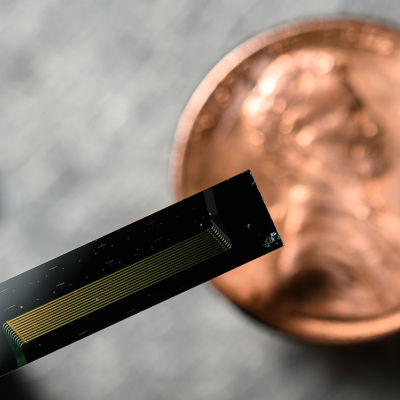

Researchers from the University of Rochester and University of California, Santa Barbara, have created a small laser device, about the size of a penny, that can improve technologies like self-driving car sensors and experiments detecting gravitational waves, which are ripples in space-time used to study the universe.
This laser uses optical metrology, a method that measures physical properties of objects with light. Traditional optical metrology needs large, costly equipment to control laser waves precisely, making it hard to create compact, affordable systems.
The new laser is built on a chip and can change its light color across a wide range very quickly - about 10 quintillion times per second. It uses a material called lithium niobate, a synthetic crystal, and a phenomenon called the Pockels effect, where an electric field changes how light moves through the material. This allows the laser to make fast, accurate measurements. Unlike older systems that use silicon photonics, a technology for guiding light on chips, this laser offers better control and speed.
A study describing the new laser is published in Light Science & Applications.
Demonstrating real-world applications
The researchers showed how their laser can power a LiDAR system, a technology that uses lasers to measure distances and create 3D maps, often used in self-driving cars. In a test, the laser was placed on a spinning disc and identified the letters "U" and "R" made from LEGO blocks. This small-scale test suggests the laser could detect cars or obstacles at high speeds and long distances when scaled up. The laser supports an advanced version of LiDAR called frequency-modulated continuous-wave LiDAR, which needs rapid changes in laser frequency, something this device can handle well.
The laser also supports a technique called Pound-Drever-Hall locking, which stabilizes a laser’s frequency to reduce noise. This is crucial for optical clocks, devices that measure time with extreme precision. Normally, this process requires bulky equipment, like lasers and modulators, about the size of a desktop computer. The new chip-scale laser combines these functions into a tiny, electrically tunable device, making it more practical.