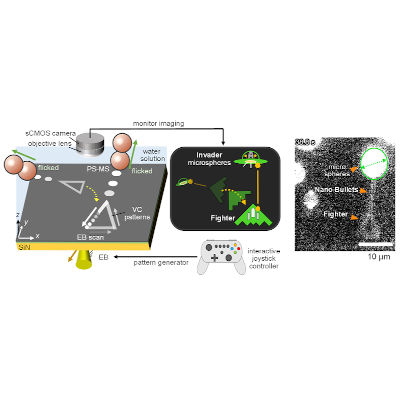

Researchers have used nanoparticles to build the tiniest shooting game ever. This game mixes real tiny objects with digital ones.
The researchers describe the methods and results of this study in a paper published in Japanese Journal of Applied Physics. Their goal is to make a computer system that connects virtual stuff with real nanomaterials smoothly.
The game combines digital technology with the real nanoworld using fast-moving electron beams. These beams create electric fields and light patterns on a screen. Researchers control these fields to move nanoparticles around in real time.
This is a fun shooting game like the arcade classics. Players use a joystick to steer a triangle-shaped spaceship on the screen. The spaceship comes from the electron beam’s pattern. Players try to hit enemy characters, which are actually little polystyrene balls. Polystyrene is a type of plastic made into nano-sized spheres here.
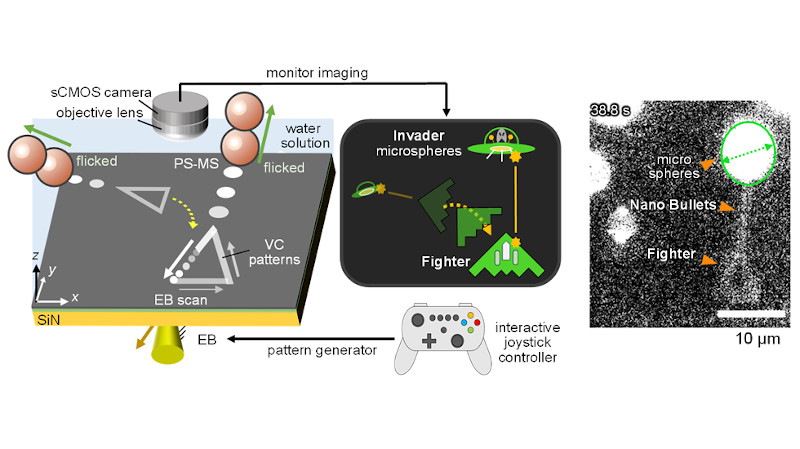
Players shoot at real nanoparticles to push them away
The researchers call this the “world’s smallest shooting game.” The system turns the digital ship into a light image and force field in real nano-space. Players shoot at nanoparticles to push them away. This proves digital data can work with real nano-objects instantly.
This technology isn’t just for fun. It could help scientists move and build tiny biological samples, like parts of cells. Nanotechnology, which is technology at the super-small scale, might benefit a lot. So could biomedical engineering, a field that mixes medicine and technology to solve health problems.
The researchers think this could change 3D printing and let engineers print tiny creations right as they design them. It could also guide harmful substances to attack virus cells in living things and destroy them. The ersearchers conclude that his tiny game opens big possibilities for science and medicine.