

I've been reading "Rad Future: The Untold Story of Nuclear Electricity and How It Will Save the World" (2025), by Isabelle Boemeke, and I totally love it. I've also watched Boemeke's interviews with Michael Shermer and Liv Boeree. Just watching her talk makes me happier: she radiates optimism and confidence, two important things that have been missing from Western culture for far too long. Boemeke has restored my confidence in her generation, which is now in charge of the world.
The author
Boemeke is a Brazilian fashion model who transitioned into nuclear energy advocacy in 2020 under the persona "Isodope." As a "nuclear influencer" she makes nuclear concepts accessible.
Boemeke has invested in Alva Energy, a startup targeting six gigawatts of new U.S. nuclear capacity in under five years, The New York Times reports (unpaywalled copy). Last fall, she and her husband, Airbnb co-founder and billionaire Joe Gebbia, donated $5 million and pledged another $5 million to nuclear causes.
Boemeke's activism includes organizing a 2021 rally to prevent the closure of California's Diablo Canyon Power Plant (then extended to 2030), where she once kissed a nuclear waste cask to demonstrate its safety.
"Rad Future" furthers her mission to rebrand nuclear energy as essential for climate solutions.
Main topics and positions
The book, written in an easygoing style, is a conversational manifesto aimed at demystifying nuclear power and positioning it as humanity's premier tool against climate change. Boemeke explicitly encourages skimming, assuring readers they don't need to grasp every technical nuance to advocate for nuclear energy, and adds a short TL;DR (too long; didn’t read) summary to all chapters. The book reframes nuclear as a "rad" enabler of energy abundance, clean air, and global salvation, starkly contrasting it with fossil fuels' pollution and renewables' scalability challenges. Boemeke consistently uses the term "nuclear electricity" instead of "nuclear energy" because the latter "has a lot of baggage," for example related to nuclear bombs. "Calling it 'nuclear electricity' highlights the use of this technology I am advocating for: making electricity," she says.
Boemeke uses simple analogies to explain nuclear fission and fusion to all readers, including those readers with no previous knowledge of nuclear physics and technology and no special interest in these things. She wants to "make complicated and boring stuff easy and fun to understand" and doesn't emphasize science or use technical references. At the same time, "every piece of data in this book has been fact-checked by multiple experts," she says. "Opinions and sass, on the other hand, are my own."
Boemeke emphasizes nuclear's efficiency: a single plant powers millions reliably, without solar or wind's intermittency. Historical context follows, from nuclear's bomb origins to its peaceful electricity pivot in the 1950s. Boemeke dissects accidents like Chernobyl (1986) and Fukushima (2011) as anomalies from poor designs, errors, or disasters, not systemic risks, comparing nuclear fears to shunning ships post-Titanic. She cites data showing nuclear's lowest death rate per terawatt-hour - safer than coal's annual millions from air pollution.
Vibe shift
Boemeke debunks nuclear waste concerns, noting all U.S. waste fits in a football field stacked 10 yards high, is securely stored in steel-and-concrete casks, and recyclable in next-gen reactors. She critiques anti-nuclear campaigns by environmentalists and media for boosting coal and worsening emissions, arguing that embracing 1970s U.S. nuclear expansion plans could have prevented most anthropogenic CO2, yielding 100% clean electricity today. Her pro-nuclear stance is firm: renewables can't scale alone for net-zero, demanding vast land, materials, and backups. Nuclear provides power for AI, desalination, and developing-world poverty reduction, enabling 100% clean energy beyond just renewable energy.
Future visions highlight innovations: small modular reactors (SMRs) for faster builds, thorium fuels, and fusion advances. Boemeke praises France's nuclear dominance (70% electricity, low emissions) over Germany's phase-out, which spiked coal use. The book urges regulatory reforms, public backing, and investment, framing nuclear as a climate survival kit. Positions are data-backed (e.g., IPCC, WHO) and dismiss critics as ideologically stuck or misinformed.
I found especially interesting the book chapter titled "Vibe Shift." The success of the campaign to save the Diablo Canyon Power Plant was, Boemeke says, "a huge milestone, signaling a drastic shift in perspective" toward a "nuclear renaissance." In the same chapter she notes that artificial intelligence (AI)'s "immense power needs" suggest that a nuclear renaissance is inevitable.
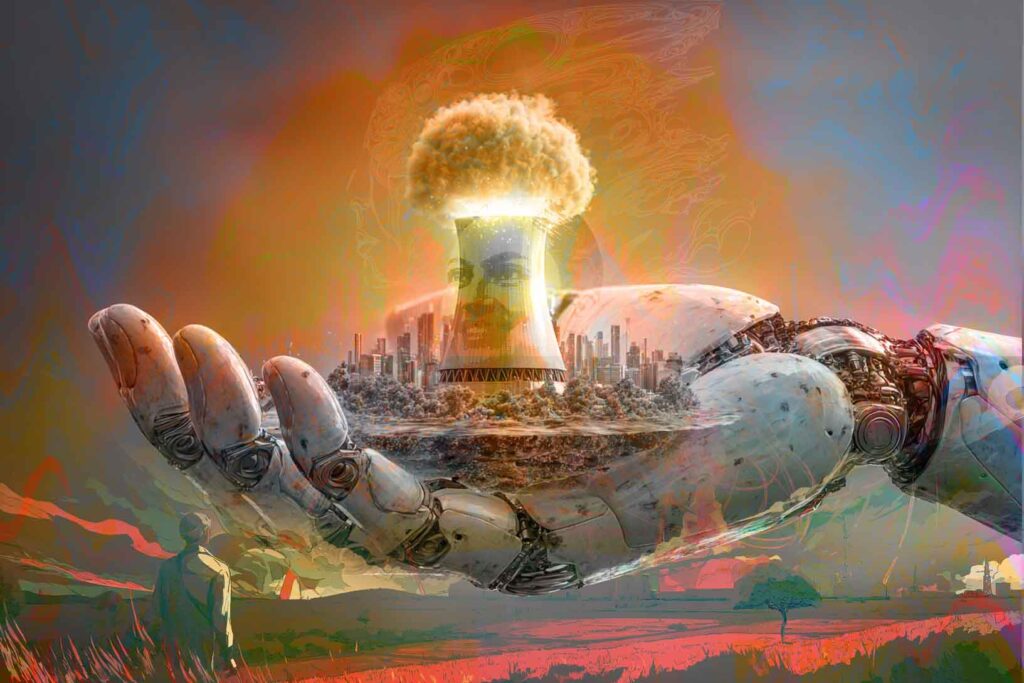
"We’re witnessing the birth of AI and its insatiable energy needs that will most likely just keep growing," reads the TL;DR summary of the chapter. "The companies behind it are betting big on nuclear electricity to meet those needs and are even helping us experiment with new reactor designs. In other words, the robots might save us. Not by overthrowing humanity, but by finally giving us a reason to stop being weird about nuclear electricity."
High-profile reactions
The book has elicited polarized responses, with endorsements from celebrities and experts alongside criticism from skeptics. Planetary scientist Carolyn Porco, a longtime nuclear advocate and friend of Boemeke, recommends it for bypassing "jargon & fear-mongering." Nuclear engineer Nick Touran deems the book "hands down, the best way to get oriented to the modern happenings in nuclear power."
Of course there are also critics, but I find them too boring. I prefer listening to Porco, who calls Boemeke "the real deal" despite the attacks of those detractors who, having no solid arguments, question the credentials of a former fashion model.
Optimism and confidence
Boemeke rejects "degrowth" as defeatist. She condemns those ecologists who seem to think that humans are evil. "More depressing than the antihuman rhetoric is the pervasive vibe of hopelessness in the air," she says. "This pessimism is crushing, especially for younger people."
Boemeke has, instead, a confident and wildly optimistic outlook. Her confident optimism is inspired among others by David Deutsch. In his book "The Beginning of Infinity" (2011), "Deutsch makes the case that humans aren’t bad or insignificant," she says. "According to Deutsch, we might be the coolest thing in the entire universe."
"Deutsch believes humans are special because of our unique ability to create knowledge and use it to solve problems and transform the world around us," she continues. "And here’s the really cool part: He argues that every problem is solvable, provided we have enough information about it."