
Artificial intelligence (AI) requires bigger and more complex models. Yet, the need for greater power and computing strength grows quicker than what standard digital computers can offer. To address this, studies now explore physical neural networks. These are analogue circuits that use natural laws of physics, such as properties of light waves or quantum effects, to handle data processing directly, rather than relying on electronic switches.
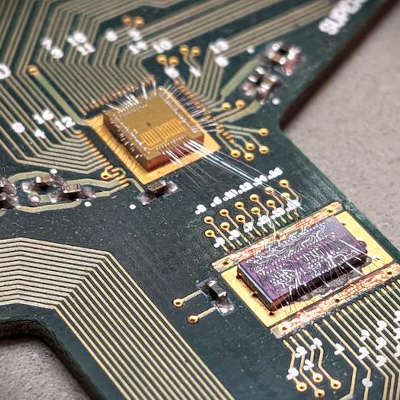
A recent study published in Nature explores training these networks. The paper, titled "Training of Physical Neural Networks," results from work by several institutions, including Politecnico di Milano, École Polytechnique Fédérale in Lausanne, Stanford University, University of Cambridge, and Max Planck Institute. Researchers at Politecnico di Milano developed photonic chips (here's a more detailed version of the press release), which are small silicon devices a few square millimeters in size that perform calculations using light.
These chips carry out basic math operations, like addition and multiplication, through light interference. Light interference occurs when light beams overlap and create patterns that represent numbers. By skipping the step of converting light signals to digital form, the chips cut down on energy use and speed up processing. This makes AI, which often depends on power-hungry data centers, more eco-friendly.
Advances in training methods
The Nature paper focuses on the neural network training phase. The researchers introduced in-situ training for photonic neural networks. The training happens right on the physical device, using only light signals without any digital computer models. This method makes training quicker, stronger against errors, and more effective overall. It allows the network to adjust itself based on real light inputs, improving accuracy for complex tasks.
Such photonic chips pave the way for advanced AI systems. They support models that process data instantly on location, like in self-driving cars or smart sensors in handheld gadgets, without sending information to distant servers. This shift promises lower environmental impact and broader use of intelligent tech in daily applications.