
Scientists at Auburn University have created a new type of material that allows to control electrons in ways that could speed up making chemicals and materials, or make computers work much faster. Electrons power everything from chemical reactions to electronic gadgets. In this material, electrons can move freely across a solid surface instead of sticking to atoms, opening up fresh uses in technology and industry.
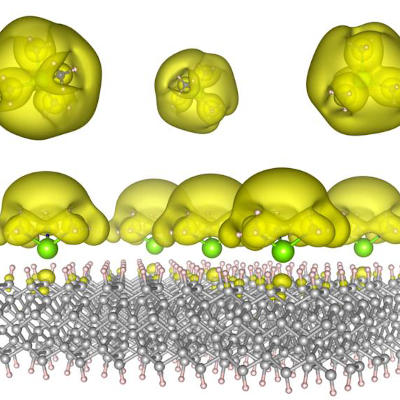
The discovery focuses on structures called electrides. These are special materials where electrons act like a gas, roaming through empty spaces without being tied down. Normally, electrons in solids are bound to atoms, which limits what they can do. But in electrides, their freedom enables new behaviors, like better energy transfer or conductivity, which is how well electricity flows. The Auburn researchers used computer models to design these electrides by attaching molecules called solvated electron precursors, which hold electrons loosely, to strong surfaces such as diamond or silicon carbide. This setup makes the materials stable and easy to adjust.
By changing how the molecules line up, the electrons can form different patterns. In one pattern, they create small, separate zones that work like qubits. In another pattern, the electrons spread out into a connected layer that acts like a metal sheet, perfect for catalysis.
Free electrons in action
Past electrides were shaky and hard to make in large amounts, but anchoring these molecules to solid surfaces fixes that. This lets the materials go from ideas on paper to real devices. The work could lead to laptops that crunch data in seconds or supercomputers that learn like brains, adapting on the fly. It also promises simpler ways to build complex compounds, cutting steps and costs in industry.
By mastering these free electrons, researchers can push beyond what nature allows, inventing tools for problems we face today. The scientists have described the methods and results of this study in a paper published in ACS Materials Letters.