
Introduction
Imagine a simple machine that can learn almost any image. This is what researchers showed with Visual Autoregressive (VAR) Transformers. These models can work in a simple way but still handle very hard image tasks. The researchers proved that even the smallest form of this model with just one attention layer can learn any change from images.There is also another model called FlowAR, which combines the benefits of normalizing flows with autoregressive transformers. Both VAR and FlowAR models rely on the principle of universal approximation so that they can learn any transformation with enough precision. In this article we will cover how these models work, why they are important, and what this could mean for the future .
How does VAR Transformers work?
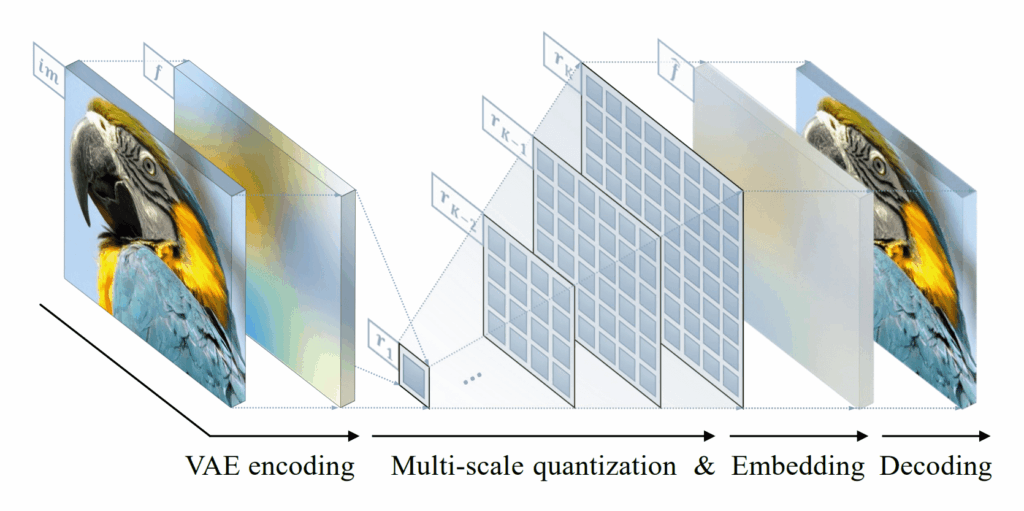
VAR Transformers do not create images pixel by pixel. Instead of predicting a single token next, VAR predicts entire token maps at progressively higher resolutions, starting from a quantized feature map and building up to the original resolution. This method is called next-scale prediction. It lets the model make clear and high-quality pictures faster and better than older diffusion models. The key idea is to go from low resolution to high resolution step by step. Using this model can focus on the big structure first and then add fine detail. It is like how a painter starts with a sketch and then adds colors and small features later.
Universality of VAR Transformers
It showed something surprising. Even a very small VAR Transformer, with only one self-attention layer and one interpolation layer, can act as a universal approximator. This means it can copy any smooth mapping between images. Great power can come from simple structures. The idea of universal approximation is important in machine learning. It means that the model can learn a very wide range of functions. Even if the model looks small, it still has the power to learn very complex relations. This result helps us understand that sometimes less is more in model design.
Universality of FlowAR
The team also looked at flow-based versions of VAR Transformers. These models use flow layers, which are invertible. They found that these models can also act as universal approximators. This shows that the idea works across different designs, not only one type. Flow models are interesting because they can map one image into another in both directions. This means the same model can create and also reverse the process. The fact that VAR Transformers keep their universal power in flow form makes the result stronger. It shows that the core idea is not limited to one design, but is general and flexible.
Practical Implementation of the Theory
Even if this is theoretical, it connects to real work. VAR Transformers already show good results in tests. They even beat diffusion models in some cases. This proof makes us trust that their success is not luck, but comes from strong design. The researchers' finding explains why this success occurs and provides practical design principles for building efficient and effective VAR models. These guidelines can help engineers develop more advanced architectures for image generation and related tasks, boosting confidence in their performance and opening new directions for exploration.

Why This Matters
Universal approximation is not only a theory game. It means that the model has the ability to learn almost any task in its field. For visual tasks, this can mean image creation, image repair, style change, and more. If a small model can do all of this in theory, then bigger models based on the same design can be very powerful in practice. This can lead to lighter models that run faster and use less energy. It can also make AI tools more available for people who do not have large computer systems. In a world where AI is growing fast, such efficient designs can make a big difference.
Conclusion
This presents a simple but deep idea. VAR Transformers, even in their smallest form, can learn any smooth image change. This universal power shows that we can make strong models without large and heavy designs. In the future, this work can lead to lighter and smarter AI systems. It inspires new ways to mix theory together with practice. The main lesson is that sometimes very small changes in design can open the door to very big progress.
Reference
Yifang Chen et al., “Universal Approximation of Visual Autoregressive Transformers,” arXiv.org, February 10, 2025, https://arxiv.org/abs/2502.06167.