
In the ever-evolving world of artificial intelligence, neural networks continue to surprise us with their capabilities. A groundbreaking paper titled "Navigating the Latent Space Dynamics of Neural Models" by Marco Fumero, Luca Moschella, Emanuele Rodolà, and Francesco Locatello introduces a fresh perspective on autoencoders (AEs)—those workhorses of representation learning. Instead of viewing them merely as compressors of data, the researchers propose seeing them as dynamical systems that implicitly define a "latent vector field." This field, born from iterating the encoder-decoder process, reveals attractors—stable points that encode crucial insights about the model's behavior, from memorization to generalization.
This article dives into the paper's key ideas, methods, and experiments, highlighting how this novel lens can probe neural models without data, detect out-of-distribution samples, and more. Let's explore how these latent dynamics could reshape our understanding of AI.

The Core Idea: Autoencoders as Dynamical Systems
At its heart, an autoencoder takes high-dimensional input (like an image) and maps it to a lower-dimensional latent space via an encoder, then reconstructs it with a decoder. The paper's innovation? Iterating this process creates a vector field in the latent space. Starting from any point z, apply f(z) = E(D(z)) repeatedly, and trajectories emerge, often converging to attractors.
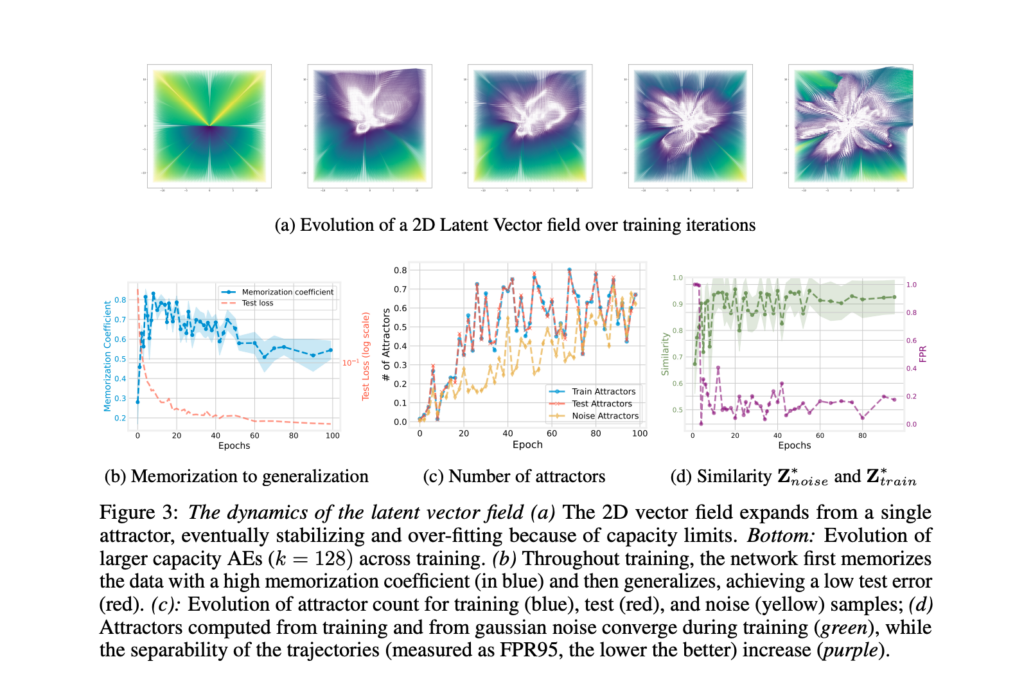
Why does this happen? Training biases—like weight decay, data augmentations, and bottlenecks—make the mapping contractive, pulling points toward stable states. As shown in the paper's Figure 1, these fields visualize how models "flow" data toward high-density regions.
How Latent Vector Fields Reveal the Inner Workings of Neural ...
Theoretically, the paper links these dynamics to the data's score function (gradient of log-density), meaning the field pushes points toward likely data modes. Attractors aren't just artifacts; they summarize the network's learned knowledge.
Memorization vs. Generalization: A Spectrum Revealed
One of the paper's standout contributions is connecting attractors to the memorization-generalization tradeoff. In over-regularized models (e.g., small bottlenecks), attractors mimic training data—pure memorization. As regularization eases, they become prototypes for broader generalization.
Experiments on datasets like MNIST and CIFAR-10 quantify this: A "memorization coefficient" (cosine similarity to nearest training point) drops as bottleneck size grows, while test error improves. Figure 2 from the paper illustrates this beautifully, with attractors evolving from data copies to abstract representations.
During training, models start by memorizing (high coefficient, many attractors) then generalize (fewer, more expressive attractors). Noise-initialized attractors converge to training ones, but trajectories differ—key for later applications.
Predictive learning as a network mechanism for extracting low ...
| Bottleneck Dimension | Memorization Coefficient (MNIST) | Test Error (MNIST) |
| 2 | 0.95 | 0.45 |
| 16 | 0.75 | 0.15 |
| 256 | 0.40 | 0.05 |
This table, inspired by the paper's results, shows the inverse relationship between memorization and generalization.
Probing Foundation Models Without Data
The real excitement comes with vision foundation models like Stable Diffusion's AE or ViT-MAE. By computing attractors from Gaussian noise (data-free!), the researchers recover semantic dictionaries embedded in the weights.
Using Orthogonal Matching Pursuit, noise attractors reconstruct diverse datasets (e.g., ImageNet, medical images) better than random bases—at lower sparsity levels. Figure 4 visualizes this: Attractors capture "prototypical" features from pretraining on billions of images.
This "data-free weight probing" unlocks prior knowledge without inputs, a boon for interpretability.
Foundation model of neural activity predicts response to new ...
Detecting Distribution Shifts with Trajectories
Trajectories aren't just paths—they encode distribution info. For OOD detection, score samples by trajectory distance to training attractors. On ViT-MAE, this outperforms KNN baselines (e.g., FPR95 of 25-30% vs. 34-100% on benchmarks like iNaturalist).
Figure 5's histograms show clear separation: In-distribution paths hug attractors; OOD ones diverge.
Implications and Future Horizons
This work bridges neural networks and dynamical systems, offering tools to analyze generalization, extract priors, and spot anomalies—all from the model's own latent flows. For practitioners, it means better debugging of AIs; for theorists, new proofs tying contractions to densities.
Limitations? It focuses on AEs, but extensions to classifiers or LLMs (via surrogate AEs) are teased. Future work might align fields across models or track finetuning dynamics.
In a field chasing bigger models, this paper reminds us: Sometimes, the deepest insights come from looking inward—at the flows within.