

Introduction
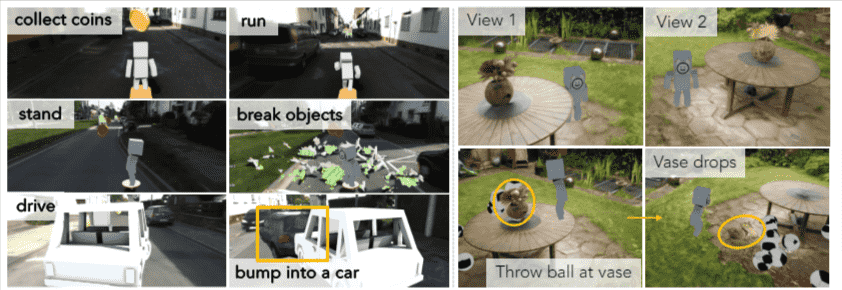
Crafting immersive worlds for games and simulations is notoriously difficult and expensive. Take Grand Theft Auto V, famed for its rich detail – it holds the title of one of the most expensive games ever made, with a staggering $265 million budget, primarily for creating its environment. And its successor Grand Theft Auto VI, reportedly in development for over a decade, is estimated to push the boundaries even further, with a cost ranging from $1 billion to a $2 billion. What if we can change that? Video2Game is a cutting-edge technology that transforms video footage into interactive video game environments. By leveraging advanced computer vision and machine learning techniques, Video2Game can analyze video input, recognize and track objects, and recreate scenes in a digital format that users can interact with in real-time. This technology has the potential to revolutionize game development, allowing creators to use real-world videos as the basis for their games, significantly reducing the time and resources required for creating game assets. Additionally, Video2Game can enhance immersive experiences in virtual reality and augmented reality applications, bridging the gap between real-world media and interactive entertainment.
Video2Game
Video2Game aims to convert a sequence of images or a video into an interactive digital twin, allowing for the creation of real-time games or realistic simulators. Unlike traditional methods that focus solely on visual appearance, Video2Game emphasizes both high-quality rendering and physical interactions, such as navigation and manipulation. The system uses a compositional implicit-explicit 3D representation to model and simulate physical properties and interactions effectively. The overall framework of Video2Game involves capturing a scene from a video, processing it through NeRF for 3D representation, converting it into a game-engine-compatible format, decomposing the scene into interactive entities, and integrating it into a web-based platform for real-time interaction. This comprehensive approach ensures a high-quality, interactive gaming experience built from real-world video footage.
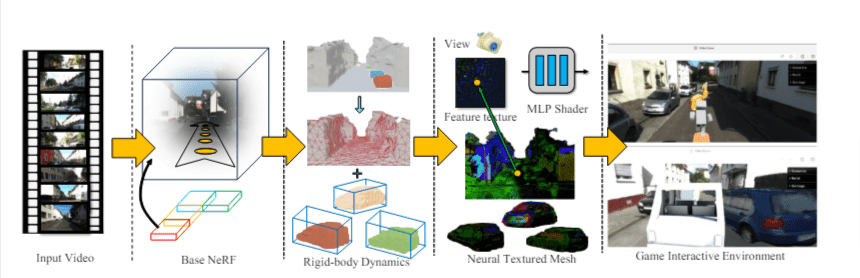
Key components of the system:
1. NeRF Model
NeRF (Neural Radiance Field) is a cutting-edge technique in novel view synthesis that uses deep learning to capture the geometric and visual information of a scene from multiple viewpoints. Here’s how it works in Video2Game:
- Geometric and Visual Information Capture: NeRF models can represent the 3D structure of a scene by learning from a series of 2D images. It encodes both the geometry (shape and spatial layout) and appearance (color and texture) of the scene.
- Large-Scale, Unbounded Scenes: Unlike traditional methods that may struggle with extensive and complex environments, NeRF is effective at capturing detailed and expansive scenes, making it ideal for creating realistic digital twins.
2. Conversion to Game-Engine Mesh
Once the NeRF model has captured the scene, the next step is to convert this information into a format that is compatible with game engines:
- Mesh Generation: The NeRF output is transformed into a 3D mesh, which is a collection of vertices, edges, and faces that defines the shape of objects in the scene.
- Neural Texture Maps: These are applied to the mesh to maintain high-quality visual details. Neural texture maps are advanced textures generated through neural networks that enhance the realism of the rendered scene.
- Rendering Efficiency: By converting the scene into a mesh with neural texture maps, the rendering process becomes more efficient, enabling real-time interaction without compromising on visual quality.
3. Decomposition into Actionable Entities
For a truly interactive experience, the scene must be broken down into individual entities that can be manipulated and interacted with:
- Entity Decomposition: The scene is segmented into distinct objects or entities, such as characters, vehicles, and environmental elements.
- Physics Models: Each entity is equipped with physics properties (e.g., mass, friction, specularity) to simulate real-world physical interactions. This allows for actions like navigation, collision, and manipulation within the game environment.
- Physical Interaction Simulation: The decomposed entities can interact with each other based on their physical properties, enhancing the realism and interactivity of the digital world.
4. WebGL Integration
To make the interactive environment accessible and playable, the system is integrated into a WebGL-based game engine:
- WebGL-Based Game Engine: WebGL (Web Graphics Library) is a JavaScript API that allows for rendering 3D graphics in web browsers. By leveraging WebGL, the interactive game can be played directly in a web browser without the need for additional software.
- Real-Time Interaction: The integration ensures that users can interact with the virtual world in real-time, experiencing seamless navigation and manipulation within the digital environment.
- Browser Accessibility: This approach makes the game highly accessible, as users can access it from any device with a compatible web browser, broadening the potential user base.
Conclusion
Video2Game represents a groundbreaking shift in the creation of immersive digital environments, offering a cost-effective and efficient alternative to traditional game development methods. By transforming video footage into interactive game worlds, this technology leverages advanced computer vision and machine learning to deliver high-quality rendering and realistic physical interactions. With its innovative use of NeRF models, conversion to game-engine meshes, decomposition into actionable entities, and WebGL integration, Video2Game enables the creation of interactive, real-time games and simulators directly from real-world videos. This not only reduces the immense time and financial resources typically required but also broadens accessibility, allowing users to experience these virtual worlds directly in their web browsers. As Video2Game continues to evolve, it holds the potential to revolutionize the gaming industry, making the creation of rich, detailed environments both attainable and sustainable.
Reference
Xia, Hongchi, Zhi-Hao Lin, Wei-Chiu Ma, and Shenlong Wang. “Video2Game: Real-time Interactive Realistic and Browser-Compatible Environment From a Single Video, 2404.09833 (arxiv.org)