

Weathering the Future: The Ethics and Impact of Cloud Seeding

Weathering the Future: The Ethics and Impact of Cloud Seeding

Can we engineer rain without consequences? As weather control technologies advance, the ethical climate grows stormier. Are we risking the planet’s memory? Who controls tomorrow’s skies, and at what cost?
DP
Darshana Patel
Jul 22, 2025
4 min read

Introduction

On a winding journey across the country, I once met a soldier who had spent his career in the military’s weather department. As we chatted, he revealed a fascinating truth: the military had always been keenly focused on predicting the weather to align their operations. He explained that predictive meteorology could confidently forecast only up to three days out. Beyond that, uncertainty reigned. This limitation, he noted, made the idea of controlling the weather even more strategically advantageous: removing variables and turning uncertainty into a tactical advantage.

That conversation struck me. Weather manipulation isn’t just about securing sunny skies for events; it’s a high-stakes tool of power, control, and geopolitics. That’s why companies like Rainmaker (backed by Peter Thiel’s foundation) and nations like China are racing ahead in what may be humanity’s next contested frontier. 

The Science of Cloud Seeding

Cloud seeding, at its core, involves introducing substances like silver iodide or salt into clouds to stimulate precipitation. This technique, first experimented with in the mid-20th century, has evolved significantly with advancements in technology. Today, drones and sophisticated weather models are employed to increase the accuracy and effectiveness of cloud seeding, transforming it from experimental science into a tool with tangible applications.

The Players and Their Motives

Rainmaker, backed by Peter Thiel’s foundation, aims to revolutionize how we think about water resources. Their goal seems to straddle the line between technological innovation and market control. By positioning themselves at the forefront of weather modification, they not only seek to address water scarcity but also to shape the future of resource management and strategic battlefield advantage.

On the other side of the globe, China has embarked on one of the most ambitious weather modification programs in history. The country’s efforts to move clouds and induce rainfall are driven by the need to support agriculture, mitigate drought, and even clear pollution. It’s a testament to how weather control is becoming a key tool in national strategy and geopolitics.

Ethical and Environmental Concerns 

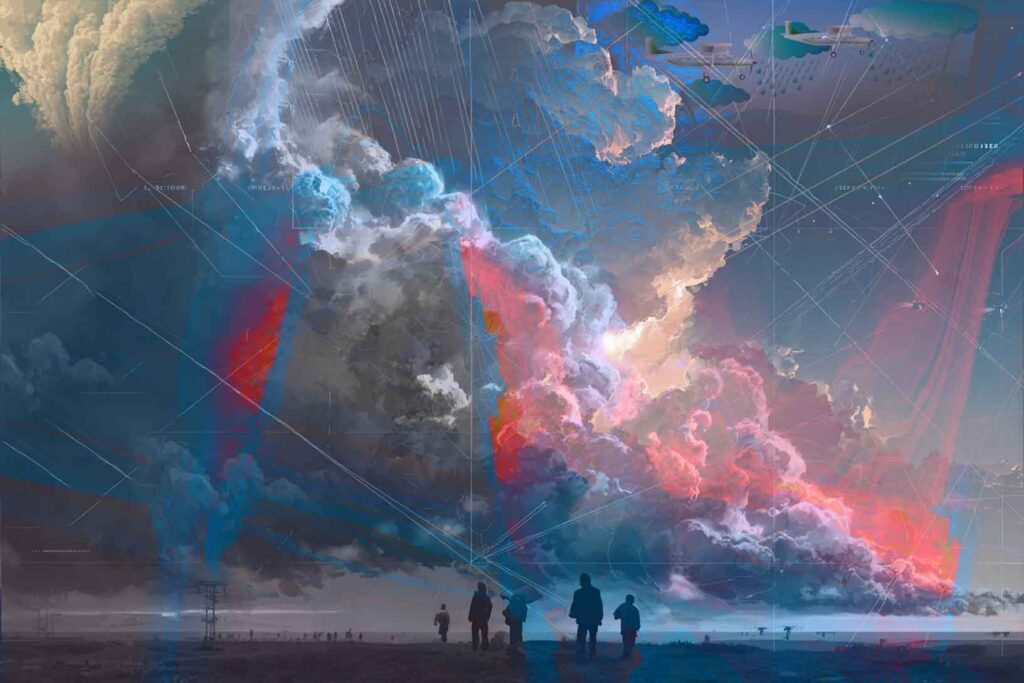
Who gets to decide when and where the weather is modified, and how do we ensure that those decisions reflect the interests of all, not just a powerful few? In many cases, cloud seeding operations occur without public knowledge or consent. Communities may find their skies altered, their rainfall diverted, or their microclimates changed, floods induced and residents displaced, all without any democratic process or local input.

Then there’s the environmental cost. While silver iodide is generally considered low-risk in small amounts, the long-term cumulative effects of sustained cloud seeding remain understudied. Manipulating natural systems without fully understanding the complex interdependencies could lead to ripple effects that only become apparent decades later. If climate change has taught us anything, it’s that small perturbations can have large, irreversible consequences.
Credit: Tesfu Assefa

The Broader Implications

Weather modification lies at the intersection of two of the most powerful forces shaping our century: climate crisis and algorithmic control. As artificial intelligence becomes increasingly adept at modeling climate systems and optimizing interventions, it raises deeper questions: are we designing tools to serve life or to dominate it?

AI-powered models can suggest ideal conditions for cloud seeding, but who determines what’s “ideal”? A tech company optimizing crop yield for profit? A military seeking strategic fog cover? Or a government aiming to prevent drought?

Just as LLMs (large language models) are trained on human conversation to predict and produce language, Weather AI may soon learn to “write” the sky. But we must remember: just because we can doesn’t mean we should. Nature is not an input/output problem to be solved. It is a living system with memory, rhythm, and intelligence of its own.

Conclusion: Water, Memory, and Power

Water is more than H₂O. It is a memory. It is a movement. And increasingly, it is control.

Whether in the form of cloud seeding, predictive AI models, or speculative futures of climate intervention, the manipulation of weather reveals deeper patterns about how we view nature and ourselves. The question isn’t just whether we can make it rain. It’s who gets to decide, who benefits, and what sacred systems are we willing to rewrite in the process?

The clouds are no longer just drifting overhead. They’re being scanned, seeded, and steered. As we face a climate-uncertain future, we must ask not only what’s possible, but what’s ethical. Because in a world where power flows with the weather, we’d do well to remember: Mother Nature always has the final say.

About the Writer

DP

Darshana Patel

0 MPXR
Ex-tech executive turned truth-seeker with 30+ years in software, systems, and social engineering. Now exploring where cutting-edge technology meets consciousness—from root chakra to root cause. Sharing stories that illuminate bias, agency, and the human soul beneath the code. Creator of IONATION® - the framework for Vibrational Intelligence, an ontological layer for adaptive, emergent, and ethical AGI. Beyond technology and transformation, I’m deeply attuned to the rhythms of life, whether found in percussion, poetry, or the pulse of human experience. As a lifelong percussionist and poet, I weave beats and words to explore truth, healing, and the unscripted journeys that shape us all. My poetry book, Turn the Tables: Poetry & Algorhythms, is an invitation to reconnect with your own inner rhythm and story. Pick up a copy on Amazon and journey with me through verse, vibration, and transformation. Peace!

More from Mindplex

Keep reading

Three more ideas worth your time.

Browse Magazine

Discussion

Join the discussion

Sign in to share a response with the community.

Type @ to mention someone Type / or use + to add a block Highlight text, then choose Link
Loading editor

Comments cannot be edited after posting because they become part of the reputation record. Give yours a quick review first.

We all agree that nature is a mother for everyone. But sometimes it is difficult to say nature has been a very good mother since history tells us how so many people had suffered from droughts, flooding, and heavy rains on countless times throughout the world. We also historically know that great cities like London were fogged with toxic gases because of the combination of natural and industrial acts.

Therefore as this article suggests being ethically able to predict what is coming ahead and acting to prevent it or change it to a favorable thing can be one form of taking advantage of the rapidly progressing AI technology.

DB

Dawit Birhanu

1 year ago

You raise vital ethical and environmental concerns, and I’d like to add another perspective: the deep spiritual and cultural significance that many societies attach to weather, especially rain. For centuries, countless cultures have regarded rain not merely as a meteorological event, but as a sacred gift central to religious rituals, seasonal festivals, and acts of communal reverence.

In many Indigenous traditions, rain ceremonies are performed to honor nature’s balance. Agricultural communities often tie rainfall to divine favor and spiritual well-being. So, manipulating these natural patterns however well-intentioned could be seen as an encroachment on beliefs that view weather as something beyond human dominion.

bs

beki simma

1 year ago

why are we allowing AI to control us? What if it damages the people who developed it also? I think we should put a limit on AI usage. If we keep it this way, we will destroy humanity which keep the universe exist

Oh Darshana, humanity is always like emm just because we can, we should! Isn't it sad? I genuinely believe AI-controlled weather manipulation is one of the most terrifying developments of our time. It’s not a distant possibility, it’s happening quietly, piece by piece, behind the closed doors of military labs and research contracts. And it makes perfect sense why they'd pursue it: controlling the weather means controlling the battlefield, economies, even migration patterns and entire ecosystems. If there’s a strategic advantage to be gained (if we can), you can bet someone will weaponize it (then we should). Everyone even knows what the problem is: once that line is crossed, we’re not just tampering with nature but we’re turning the sky itself into a tool of power and coercion! But do you see anyone stopping at this point? No.

What breaks my heart is how powerless most of us are to stop it. I can read about it, shout about it, post about it, but the machine grinds on. Governments, defense contractors, and private labs will do what they want while the rest of us are fed distraction. I know people who don’t even believe this is real, because it sounds like sci-fi. But it’s not. It's quietly unfolding, and by the time the consequences hit, droughts in one country, floods in another, we'll be too late. The saddest part? Knowing all this, and realizing that awareness alone won’t stop what’s coming. I am very happy that you give the spotlight to this 'underdog' issue and thank you for your brilliant analysis.