

From emergency response to supply chains, locally governed drone networks may redefine who controls critical infrastructure.
In disaster zones, minutes can mean the difference between recovery and catastrophe. Increasingly, those minutes are measured in flight time.
Across the world, communities are experimenting with something radical: owning and operating their own drone networks to move goods, gather information, and respond to crises—without waiting for governments or corporations to act.
The convergence of affordable hardware, open-source flight software, and localized data infrastructure has quietly lowered the barrier to drone deployment. What once required military budgets or venture-backed startups can now emerge from cooperatives, municipalities, or civil society groups.
This shift aligns with broader movements in decentralized technology, from community broadband to local energy grids. In each case, the question is not just technical feasibility, but governance: who controls the system, who benefits, and who bears the risks.
The tension is clear. Drones promise speed, visibility, and reach, yet they also evoke concerns about surveillance, safety, and airspace control. Community-owned networks sit uneasily between empowerment and fragmentation, challenging existing regulatory and economic models.
Centralized drone services tend to optimize for scale and profit. Community-owned networks, by contrast, optimize for relevance: local terrain, cultural norms, and immediate needs.
In emergency response, this distinction matters. Locally operated drones can be pre-positioned, piloted by trained residents, and deployed without bureaucratic delay. The result is faster situational awareness and more adaptive logistics.
Why this matters: Ownership shapes priorities. When communities control aerial infrastructure, responsiveness often improves, and trust can be built rather than imposed.
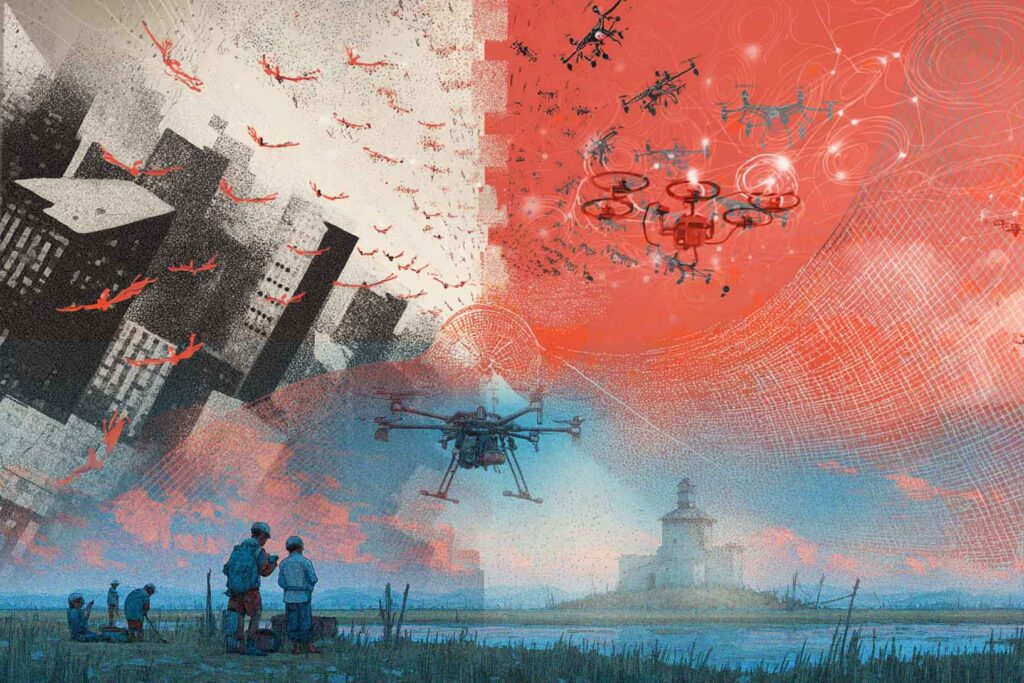
In remote or infrastructure-poor regions, last-mile delivery is often the weakest link. Drones offer a way to bypass damaged roads, traffic congestion, or geographic isolation.
Community networks can coordinate deliveries of medicine, food, or critical parts using shared routing systems. Unlike commercial platforms, these networks can operate on cost-recovery or mutual-aid models rather than per-delivery profit.
Why this matters:Resilient supply chains are not just about efficiency; they are about continuity under stress, especially where traditional logistics fail.
At the core of these networks are lightweight drones, mesh communication protocols, and semi-autonomous navigation systems. Advances in onboard AI allow drones to adapt to weather, obstacles, and changing missions.
Crucially, data does not have to flow to distant cloud servers. Edge computing enables local processing, reducing latency and limiting external data exposure.
Why this matters:Technical architecture determines political possibilities. Systems designed for local control make local governance viable.
Operating a shared drone network raises questions usually reserved for utilities: access rights, maintenance responsibilities, and conflict resolution.
Some communities experiment with cooperative models, others with municipal oversight or hybrid public–civic arrangements. Rules for airspace use, data retention, and emergency override must be explicit and enforceable.
Why this matters: Technology alone does not decentralize power. Governance frameworks decide whether community ownership is meaningful or symbolic.
A persistent challenge is scale. Can community networks interoperate across regions without reverting to central control?
Federated models offer one answer. Local networks retain autonomy while adhering to shared protocols for safety, identification, and coordination during large-scale crises.
Why this matters:The future may depend on systems that scale horizontally, not vertically—through cooperation rather than consolidation.
Community-owned drone networks complicate traditional narratives of surveillance and control. When residents operate the system, the line between watcher and watched blurs, demanding new norms of consent and transparency.
There are risks. Informal governance can fail under pressure, and uneven access to technical skills may reproduce local inequalities. Without safeguards, even community systems can drift toward exclusion or misuse.
Yet the broader implication is hopeful. These networks suggest a future where advanced technology does not automatically centralize power, but can be shaped to serve collective resilience and shared agency.
Conclusion
Community-owned drone networks reveal a different trajectory for emerging technology—one grounded in local knowledge, shared responsibility, and pragmatic innovation.
As climate shocks and supply disruptions become more common, the question is no longer whether drones will be part of our infrastructure, but who will be trusted to fly them.