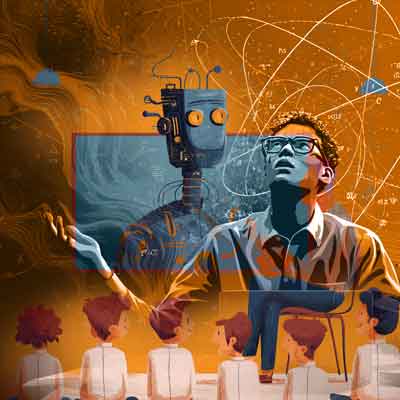

The global teacher shortage already exceeds tens of millions and is still growing.
In many developing nations, classrooms routinely contain fifty or more students per instructor, making individualized education nearly impossible. AI tutors introduce a radical possibility: education systems built not around scarce human teachers, but around infinitely scalable personalized instruction.
Education has historically scaled through standardization. Industrial-era schooling models were designed to educate large populations efficiently, producing literate workers for bureaucratic and industrial economies. The classroom itself became a technology for mass coordination rather than personalized learning.
Today, artificial intelligence is disrupting that assumption. Large language models, adaptive learning systems, and multimodal AI interfaces can simulate tutoring interactions once available only to elite students. At the same time, developing countries face rapidly expanding youth populations and insufficient educational infrastructure to meet demand.
The tension lies in whether AI tutors represent empowerment or replacement. Do they democratize access to high-quality learning, or risk creating automated education systems that prioritize efficiency over human development? The answer may determine whether AI narrows or widens global knowledge inequality.
The Historical Accident of the Classroom
Modern schooling feels inevitable, but it is largely a product of industrial constraints. One teacher addressing many students was not pedagogically idea it was economically necessary.
Research in cognitive science consistently shows that one-on-one tutoring dramatically improves learning outcomes compared to lecture-based instruction. Yet human tutoring has always been expensive and scarce. Educational systems accepted compromise as the only scalable option.
AI tutors alter this equation by simulating individualized interaction at near-zero marginal cost. Each student can receive tailored explanations, pacing adjustments, and continuous feedback.
Why this matters:
If personalization becomes scalable, the classroom may no longer be the primary unit of education.

Intelligence as Educational Infrastructure
AI tutoring systems function as adaptive cognitive interfaces. They analyze student responses, detect misunderstandings, and dynamically adjust teaching strategies. Instead of progressing through fixed curricula, learners follow evolving knowledge pathways shaped by performance data.
Technically, these systems combine natural language processing, reinforcement learning, and knowledge graphs that map conceptual dependencies between topics. A student struggling with algebra might automatically receive foundational arithmetic reinforcement before advancing.
For developing nations, this transforms education from a staffing problem into an infrastructure problem. Devices, connectivity, and software updates replace decades-long teacher training pipelines as the primary bottlenecks.
This reframing resembles how mobile phones allowed countries to leapfrog landline infrastructure entirely.
Why this matters:
Educational capacity could scale rapidly without waiting generations to train sufficient teachers.
The Developing-World Advantage
Paradoxically, countries with weaker legacy education systems may adapt fastest. Wealthy nations possess entrenched institutions, regulatory frameworks, and professional structures resistant to rapid change.
Developing regions often demonstrate higher adoption rates for mobile banking, telemedicine, and digital services precisely because fewer legacy systems exist. AI tutoring may follow a similar trajectory.
Students already learning via smartphones or shared digital centers may integrate AI learning tools more naturally than systems built around rigid standardized testing regimes. Local adaptation—language support, culturally relevant examples, and offline functionality—could accelerate adoption further.
Rather than catching up to Western education models, some nations may move beyond them.
Why this matters:
Educational innovation may originate from regions historically considered technology followers.
The Teacher’s Role After Automation
Contrary to popular fears, AI tutors may not eliminate teachers but redefine their function. Human educators shift from information delivery to mentorship, social development, and ethical guidance.
AI excels at repetition, personalization, and instant feedback. Humans remain essential for emotional intelligence, motivation, and contextual judgment. The teacher becomes a learning architect rather than a lecturer.
This hybrid model may improve job satisfaction while increasing educational reach. However, it requires retraining educators and redefining professional identity a cultural shift as significant as technological adoption.
Why this matters:
The success of AI education depends less on software capability than on how societies redesign the human role in learning.
Knowledge, Language, and Cognitive Power
Language has always shaped access to knowledge. Many students worldwide learn through second or third languages imposed by colonial or global systems, creating cognitive barriers to understanding.
AI tutors capable of multilingual dialogue and local dialect adaptation could reduce these barriers dramatically. Concepts explained in familiar linguistic and cultural contexts improve comprehension and retention.
Yet language models also carry embedded biases from training data. Without localized datasets and governance, AI tutors risk exporting dominant cultural assumptions along with educational content.
Education becomes not just a technological system but a cultural interface.
Why this matters:
Who trains AI tutors may influence how future generations think, reason, and interpret the world.
The Risk of Algorithmic Education
Personalization introduces new risks. AI systems optimize for measurable outcomes, potentially narrowing learning toward quantifiable performance metrics.
Curiosity, creativity, and intellectual struggle difficult to measure may receive less emphasis if systems prioritize efficiency. Over-reliance on automated tutoring could also weaken peer collaboration and social learning experiences.
Moreover, centralized AI platforms could gain unprecedented influence over national education systems, shaping curricula indirectly through algorithmic design choices.
Education, once governed locally, could become partially controlled by invisible computational architectures.
Why this matters:
The architecture of learning systems quietly determines the intellectual culture of future societies.
Ethics & Societal Implications
AI tutors challenge foundational assumptions about education as a human relationship. If learning increasingly occurs through interaction with machines, societies must reconsider how empathy, citizenship, and shared cultural understanding are transmitted.
There are also governance risks. Educational AI systems could become powerful instruments of influence, subtly shaping ideology through curriculum design or response framing. Transparency, local oversight, and pluralistic content ecosystems will be essential safeguards.
At the same time, AI tutoring could dramatically expand educational equity. Rural learners, displaced populations, and underfunded schools may gain access to instruction previously unavailable. The ethical challenge is ensuring access without surrendering intellectual autonomy to centralized technological actors.
Conclusion
AI tutors may represent not merely a tool for education reform but a redesign of how societies transmit knowledge across generations. Developing nations, often constrained by teacher shortages and infrastructure gaps, may find themselves uniquely positioned to pioneer this transformation.
The central question is no longer whether machines can teach but whether humanity can define what learning should mean when intelligence itself becomes universally accessible. If everyone gains a personal tutor, what becomes the purpose of school?