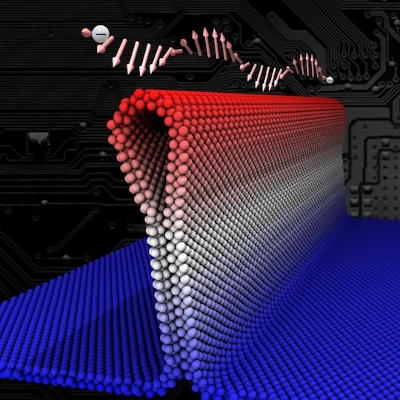

Materials scientists at Rice University have found that small wrinkles in very thin materials can help control the spin of electrons with great accuracy. This could lead to new kinds of tiny, low-power electronic devices. Most devices today use the flow of electron charge through silicon to handle information. But future tech might use spin instead. Spin is a quantum feature of electrons, like a tiny magnet that points up or down. Using spin, called spintronics, could save energy in devices and data centers, especially as computing uses more power worldwide.
A big problem in spintronics is that spin information fades quickly when electrons are scattered by atoms. In a study published in Matter, the scientists showed that bending thin layers of materials like molybdenum ditelluride creates a special spin pattern called persistent spin helix, or PSH. PSH is a stable spin arrangement that keeps the spin state even during collisions. In normal materials, spin links to the electron's direction of movement, so changing path changes spin. But in PSH, the spin stays fixed.
How bending creates stable spins
The scientists thought wrinkles in these 2D materials - flat sheets just atoms thick - could manage spin states. When bent, the top stretches and the bottom squeezes, shifting charges and making an internal electric field. This is flexoelectric polarization, where shape change causes electric effects. The bend interacts with electron spins, splitting up-spin and down-spin into separate paths. Stronger bends mean stronger effects, forming the PSH where spins flip over just 1 nanometer. This short flip distance allows very small devices.
Wrinkles or folds in these materials naturally have high bends, achieving the shortest PSH flip length ever seen. The scientists noted that simple bends in 2D materials create unique electric fields for spin control. This links big shape changes to deep quantum effects between spin and atom cores.