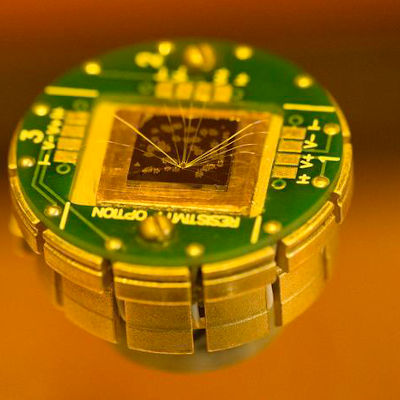

Digital data is growing fast and could soon use up to 30 percent of the world's energy. Memory devices store and process this information in things like smartphones, computers, and artificial intelligence (AI) systems. These devices often use magnetism, which involves how electrons behave in materials under electric currents or fields, to make storage faster and smaller. But current methods need a lot of power, so finding better ways is urgent.
Researchers at Chalmers University of Technology have created a new, very thin material that mixes two opposite magnetic types in one layer. This reduces energy use in memory by a factor of ten. The material is atomically thin, meaning it's just a few atoms thick, like a flat crystal sheet.
One of the two magnetic types is ferromagnetism, where electrons line up in the same direction, creating a strong magnetic field, like in regular magnets that stick to metal. The other is antiferromagnetism, where electrons point in opposite ways, canceling out the field. Until now, combining these required stacking different layers, which was complex and unreliable.
How the new material works
This breakthrough puts both magnetic types in a single structure, using a mix of elements like cobalt, iron, germanium, and tellurium. The layers stick together with van der Waals forces, weak attractions between molecules, instead of strong chemical bonds. This setup creates a tilted magnetic alignment inside the material, so electrons switch directions easily without needing extra external magnetic fields, which are power-hungry.
Without those fields, devices use much less energy. The single-layer design avoids problems at layer joints, making production simpler and devices more reliable. It suits AI, mobiles, and data tech.
The study, published in Advanced Materials, involved growing the material, testing its structure, and measuring magnetism. Funding came from European and Swedish sources. This could lead to ultra-efficient memory, helping curb data's energy impact while opening new tech possibilities.