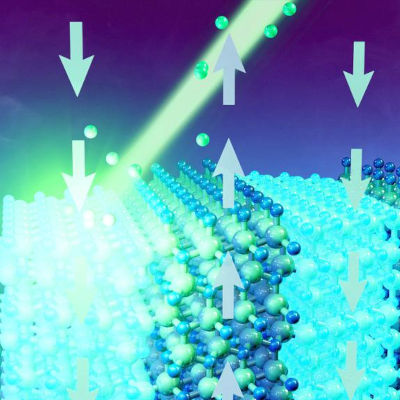

Scientists at Oak Ridge National Laboratory have demonstrated for the first time that they can directly write ferroelectric properties into aluminum nitride. They used a tightly focused beam of helium ions at the Center for Nanophase Materials Sciences. Ferroelectric materials can store data using electric polarization that can be flipped on and off. They do not need constant power, making devices more reliable and energy efficient.
Aluminum nitride is a semiconductor already widely used in 5G and Wi-Fi equipment. The new method combines this familiar material with a common manufacturing tool in a novel way.
How defects improve performance
In most ferroelectric materials, scientists avoid defects, which are small disruptions in the orderly arrangement of atoms known as the crystal lattice. However, aluminum nitride belongs to a different class of materials called wurtzite nitrides. In these materials, carefully placed defects allow narrow channels of atoms to switch polarization independently. This requires much less energy than switching the entire crystal at once.
The helium ion beam, only about one nanometer wide, creates these useful defects with atomic-level precision without destroying the crystal structure. After treatment, the material needed 40 percent less energy to switch its polarization. It also showed stronger piezoresponse, the ability to change shape when an electric field is applied. This property is valuable for wireless communication devices.
This finding is important because it enables low-power ferroelectric memory using current chip production lines, accelerating practical advances in energy-efficient electronics. It could make it easier to produce advanced memory and sensors using current chip manufacturing processes. It may also encourage researchers to explore other materials where controlled defects can create useful properties rather than problems.
The scientists have described the methods and results of this study in a paper titled "Revealing the Defect-Driven Ferroelectric Mechanisms of Aluminum Nitride," published in Advanced Materials.